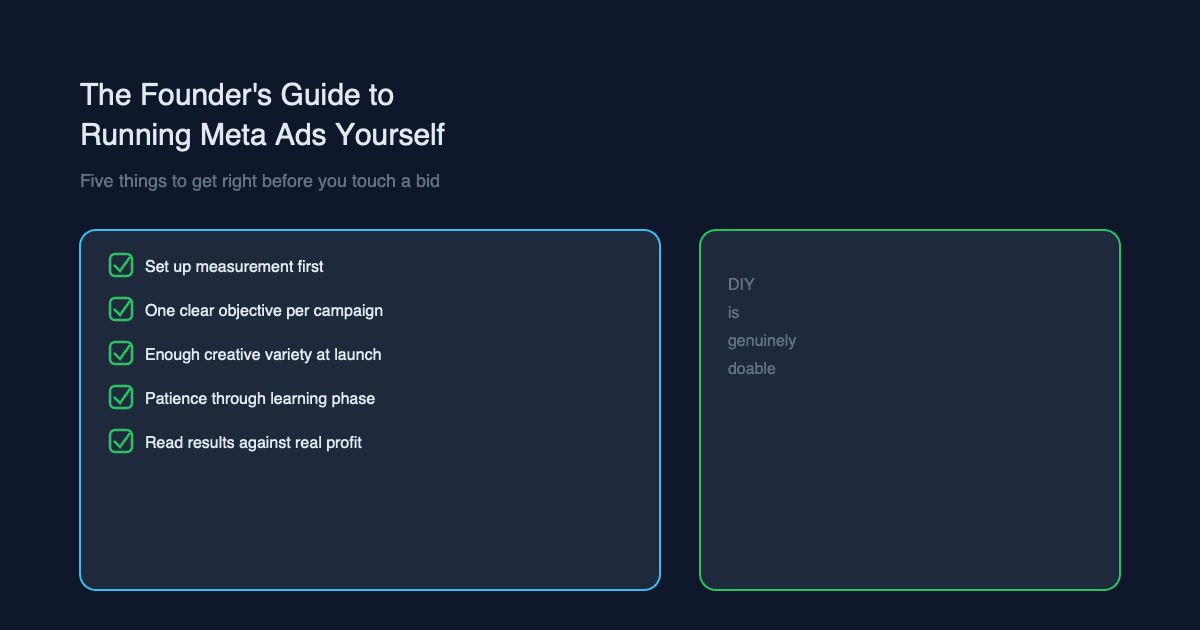
Run Meta Ads Yourself: A Founder's Setup Guide
Set up Meta ads yourself with a pre-launch checklist, a break-even ROAS table (25% margin needs 4.0x), a change-or-leave-alone guide, and a weekly routine.
By Abhilash LR
Running Meta ads yourself works when you fix tracking first, know your break-even ROAS, and edit less. Meta ads are paid placements across Meta's apps, mainly Facebook and Instagram, optimized toward a conversion event you choose. In our experience, most avoidable founder mistakes happen before launch, not after.
This guide follows the order we'd set things up. You get a checklist to copy, two tables, and a weekly routine. Budget advice here is our own arithmetic, not Meta guidance.
By Abhilash LR | Updated 19 Oct 2026
Key Takeaways
- Install the Pixel and Conversions API, then deduplicate events.
- Break-even ROAS equals 1 divided by gross margin.
- Budget each ad set for roughly 50 results a week (our arithmetic).
- Edit rarely. Even minor changes can trigger learning, per Jon Loomer.
- Review once a week, in the same slot.
What Should You Set Up Before Running Meta Ads Yourself?
Set up the Pixel, the Conversions API, deduplication, and a verified domain before spending. Meta documents the Meta Pixel as its website tracking tool. It also says you can set up the Conversions API for website events in one click from Events Manager (accessed 19 Oct 2026).
Copy this checklist into your notes and tick it off before launch day.
PRE-LAUNCH CHECKLIST
1. Meta Pixel installed and firing on the site
2. Conversions API connected (server-side events)
3. Deduplication set: same event name and event ID from both channels
4. Domain verified in Business Manager
5. One conversion event chosen (a purchase or a qualified lead)
6. Break-even ROAS calculated from gross margin
7. One-page creative brief written
8. Weekly review slot booked (same day, same time)
Need the technical steps? Our walkthrough on setting up conversion tracking covers them.
Why Does Deduplication Matter?
Without it, one sale can be counted twice. Meta's end-to-end implementation guide says "you need to set up deduplication for your events sent via both channels." That is the whole reason this item sits on the checklist.
The rule is simple. Meta's page on handling duplicate Pixel and CAPI events says, "We determine if events are identical based on their ID and name." Deduplication also only works within 48 hours. Send the same event name and the same event ID from the browser and the server.
After your first events arrive, check quality. Meta's Conversions API best practices note that Event Match Quality shows per event in Events Manager. Look at it for your main conversion.
Which Domain, Objective, and Event Should You Pick?
Verify your domain, pick one objective, and choose one conversion event. Meta's domain verification docs describe the step as how you "claim ownership of your domain in Business Manager." Do it once, early.
For objectives, Meta's campaign reference lists names such as OUTCOME_SALES and OUTCOME_LEADS (accessed 19 Oct 2026). That page is an API reference, so we cite it for names only. In Ads Manager you'll see Sales and Leads.
For the event, we pick the one closest to revenue that still fires often enough to learn from. That's our judgment, not Meta advice. If you run Advantage+ sales campaigns, budget is set at the campaign level, so apply the 50-results arithmetic to the whole campaign rather than to each ad set (Meta's developer blog, 3 Jun 2025).
Break-Even ROAS: Calculate It Before Creative
Break-even ROAS is the revenue you need per dollar of ad spend for gross profit to cover that spend. The formula is break-even ROAS = 1 / gross margin. Shopify's break-even ROAS guide puts it plainly: "A ROAS above your break-even point means you're making a profit." (2 Sep 2026)
Here's the arithmetic at three margin levels.
Illustrative arithmetic, not client data
| Gross margin | Break-even ROAS | What it means |
|---|---|---|
| 25% | 4.0 | Each $1 of spend needs $4.00 in revenue |
| 40% | 2.5 | Each $1 of spend needs $2.50 in revenue |
| 60% | 1.67 | Each $1 of spend needs $1.67 in revenue |
Why does this come before creative? Because a ROAS of 3.0 looks healthy on a dashboard. At a 25% margin, it loses money.
Illustrative example, not client data: a product sells for $50 and costs $30 to make and ship. Gross margin is 40%, so break-even ROAS is 2.5. A campaign reporting 2.0 is losing money on every order, however busy it looks.
If you want a stricter number, subtract payment fees and returns from margin first. A lower margin raises the bar. Once you know your number, track it next to your total spend and revenue in a blended CAC report in Google Sheets.
How Much Budget Does One Ad Set Need?
Plan a weekly budget of about 50 times your target cost per result. That's our arithmetic, not a Meta minimum. It comes from one figure: Meta's developer docs on the learning period say "the learning period stabilizes with a minimum of 50 events over a 7-day period." (updated 8 Apr 2026)
One caveat. That page was written for Horizon ads. We use it as a rough benchmark, and you should treat it that way too.
Illustrative example, not client data: you want leads at $20 each. Fifty leads a week means about $1,000 a week, or roughly $143 a day. At Rs 1,500 per lead, 50 leads a week is Rs 75,000 a week, about Rs 10,700 a day.
If that's too much, you have two options. Run fewer ad sets, or optimize for a cheaper event that still matters to you.
You may also see a "Learning limited" status in Ads Manager. Our reading is that it flags an ad set getting too few results to exit learning; check Meta's own wording in your account, as we haven't verified a citable definition. Check the status each week. If you see it, consolidate budget into fewer ad sets before you add anything new.
Not sure what total spend makes sense? Our guide on how much a startup should spend on Meta ads walks through it.
What Can You Change Without Restarting Learning?
Less than you'd hope. Jon Loomer, a long-time Meta ads practitioner, writes in his post on edits that trigger the learning phase that "Minor changes will result in triggering the learning phase, too." (updated 1 Mar 2025) He is a practitioner, not Meta, so read this as field experience.
The table below is our working rule, not an official Meta list.
| Safe to do any time | Can send an ad set back into learning |
|---|---|
| Reading and exporting reports | Changing the optimization event |
| Renaming campaigns and ad sets | Changing audiences or targeting |
| Drafting your next creative brief | Budget changes (no documented safe size, so keep them small and rare) |
| Building next week's test offline | Swapping or adding ads inside a live ad set |
| Updating your own spreadsheet | Changing bid strategy or cost controls |
When you want to test something new, build it as a separate campaign or ad set. Leave the working one alone. In our experience, leaving a working ad set alone is the cheapest habit to adopt.
How Many Creative Concepts Should You Launch With?
Launch with three to five clearly different concepts, not one ad with five headlines. That number is our judgment. Meta's engineering team wrote in its Andromeda announcement that "Increased ad diversity can improve people's experience with ads" (2 Dec 2024).
That sentence is about ad experience. We read it as a reason to test different concepts, which is our interpretation. A concept is a different angle: a problem, a proof point, a founder story, an offer.
Write one page before you shoot anything. Use our ad creative brief template to keep it to the audience, the promise, the proof, and the call to action.
A Weekly Review That Ends in a Decision
In our experience, a weekly review fits in under an hour and ends with a decision. Pick one slot, open one report, and compare results against your break-even ROAS. Skip daily check-ins, which tempt you into edits that restart learning.
- Open your report for the last 7 days. Note spend, results, cost per result, and ROAS.
- Compare ROAS with your break-even number from the table above. Check the attribution setting in your own account too, because it changes which results you see.
- Check Event Match Quality and confirm events still arrive without duplicates.
- Look for fatigue signs. Our post on ad fatigue on Meta lists what to watch.
- Make at most one change, and make it in a new test campaign or ad set. Leave live ad sets untouched unless the data clearly demands it. Write down what you changed and why.
- Draft next week's test offline, then book next week's slot.
The Short Version: Running Meta Ads Yourself
Fix tracking, then do the margin math, then, using our own arithmetic, fund each ad set for about 50 results a week. Launch several different concepts. Leave live ad sets alone, and review once a week against break-even ROAS. Following that order keeps your Ads Manager time short and your decisions tied to one number.
Get Your Account Audited
Loupe is a 133-point review of your Meta and Google ad accounts. It costs US$199, US$299, or US$399, with reports in 3, 5, or 7 business days. It's built for D2C and e-commerce teams spending about Rs 2.5 lakh / US$3,000+ a month with 60+ days of data. A brand-new account isn't a fit yet. No retainer, no sales calls. Book an audit or view the sample.
Still Launching? Get an Expert Team to Execute
If you're still launching, or you'd rather hand execution to a team, talk to Coact. We're a performance marketing agency working across Southeast Asia and India. Book a free strategy call for a straight read on where to start, or see what we do at coact.biz.
Disclosure: Coact sells Loupe and runs growth marketing for clients; this post links to both.
Frequently Asked Questions
Do I need the Conversions API if I already have the Pixel?
We'd run both. Meta's implementation guide covers sending events through both channels and says to set up deduplication when you do. The Pixel reports browser activity. The Conversions API sends events from your server. Deduplication keeps one sale from counting twice, within a 48-hour window.
What is a good ROAS for Meta ads?
A good ROAS is one above your break-even point, and that depends on your margin. At a 40% gross margin, break-even is 2.5. At 25%, it is 4.0. Shopify's guide says a ROAS above break-even means you're making a profit. Calculate yours before judging any campaign.
How long should I wait before judging a campaign?
Wait at least one week. Meta's developer docs on the learning period, written for Horizon ads, say it stabilizes with a minimum of 50 events over a 7-day period. We treat that as a rough guide for other campaigns. Judging after two days gives the ad set little time to gather the roughly 50 events the benchmark describes.
How much should I spend per day?
Work backward from your target cost per result. Our arithmetic is a weekly budget of about 50 times that cost, which gives an ad set a chance to reach about 50 events a week. It's not a Meta minimum. For total spend, see our guide on startup Meta ad budgets.
Which campaign objective should I choose?
Choose Sales if you want purchases and Leads if you want enquiries. Meta's campaign reference lists these as OUTCOME_SALES and OUTCOME_LEADS. Pick one objective per campaign and one conversion event per ad set. Mixed goals make results harder to read.
When should I stop running ads myself?
Stop when the account needs more hours or more judgment than you can give it. Common signs include missed weekly reviews, rising spend you can't explain, and tracking you no longer trust. Our post on when DIY stops working lists the signals in detail.
Abhilash LR leads growth marketing at Coact, a performance marketing agency working across Southeast Asia and India. Coact also sells Loupe, a fixed-price ad account audit.
Published at www.coact.biz2026-09-30 · Abhilash LRWant results like these for your brand?
COACT runs performance-based growth across SEA & India. Start with a free 15-day pilot.
Book a strategy callKeep reading
12 Questions to Ask Before You Hire an Ad Auditor
Hiring a one-time ad auditor? Ask these 12 questions on scope, turnaround, sample reports, access and guarantees, then send our copy-paste email template.
Creative Testing Spreadsheet: Formulas and Stop Rule
A Google Sheets layout, copy-and-paste formulas and a z-test stop rule for Meta and Google tests. In our worked example, a 23% lift was not significant at 95%.