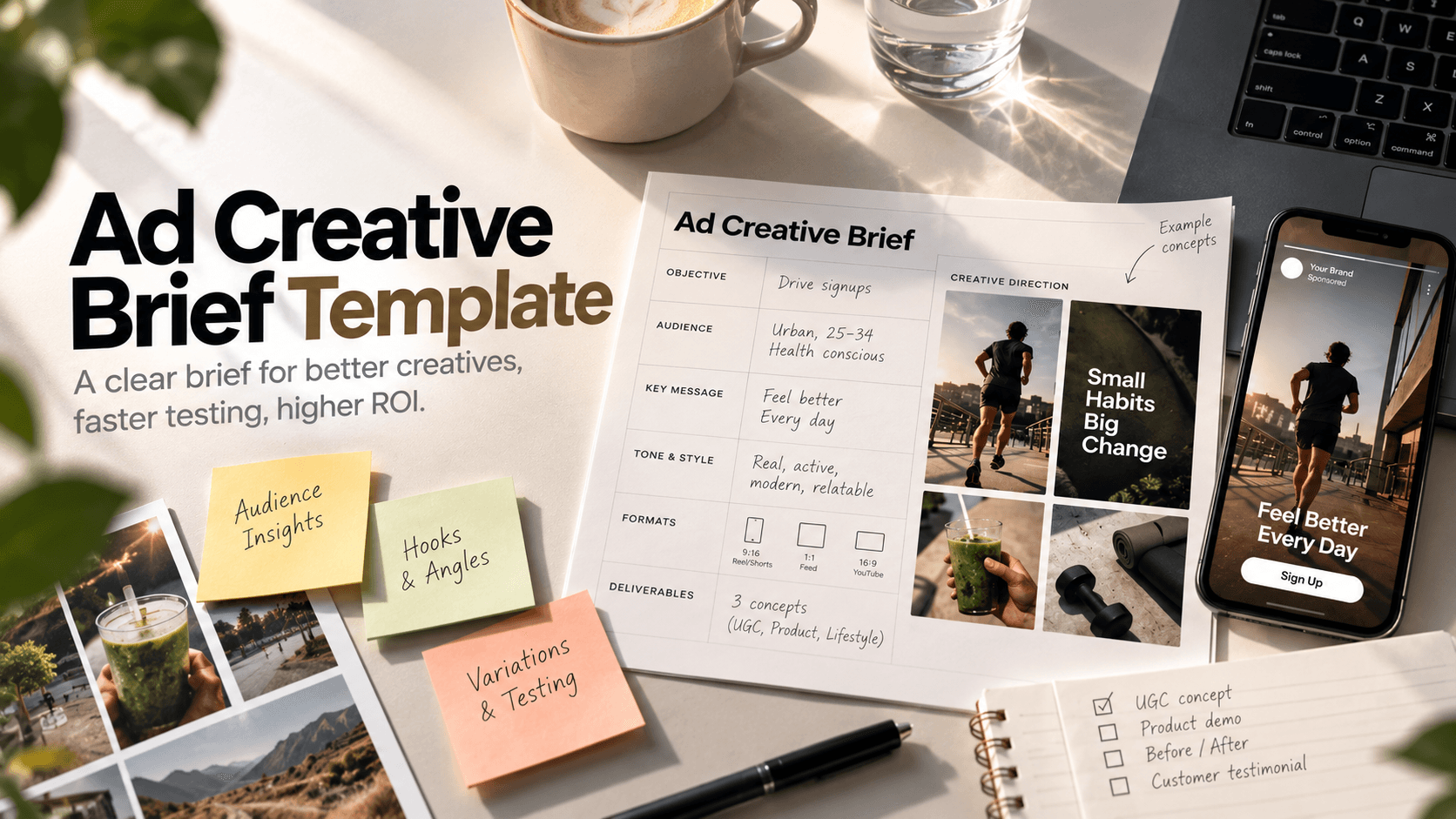
Ad Creative Brief Template: 5 Questions to Answer First
Free ad creative brief template: five fields to fill in before design starts, plus Meta and Google specs. Meta reports over 75% of Reels views are sound-on.
By Abhilash LR
An ad creative brief template works when it forces five answers before design starts: audience, problem, proof, action, and format. A creative brief is a one-page document telling designers and editors what the ad must say, to whom, and in what shape. Below: a copy-paste template, a filled example, and the platform specs your format answer must respect.
Key Takeaways
- Answer five questions first: audience, problem, proof, action, format.
- Keep it to one page, with one segment per concept.
- Put specs in the brief: Meta's developer blog reports over 75% of Reels views are sound-on.
- Brief two or three different concepts, not three edits of one.
Testing comes after the brief. Our guide to creative testing covers how to read the results.
What Should an Ad Creative Brief Template Include?
It should include five fields: audience, problem in their words, verified proof, one action, and format constraints. Each takes a sentence or two. Copy the block below, fill it in once per concept, and send it before any design work starts.
AD CREATIVE BRIEF

1. Audience: [one segment, described by behavior]
2. Problem in their words: [2-3 phrases from reviews, tickets, calls]
3. Proof (verified): [claim + source + date checked, or "none yet"]
4. Action: [one action + landing page + tracked event]
5. Format and constraints: [placement, ratio, length, sound, legal/brand limits]
Illustrative example, not client data
Here's the block filled in for a made-up running-shoe store.
- Audience: Runners who viewed a trail-shoe page in the last 14 days but didn't buy.
- Problem in their words: "My knees hurt after a long run." "Road shoes slip on wet trails."
- Proof (verified): 30-day free returns (store policy page, checked on launch day). No review stat approved yet.
- Action: Tap Shop Now, land on the trail collection, purchase event tracked.
- Format and constraints: Reels, 9:16, sound on, captions, hook and offer inside the safe zone.
Vague Answer vs Specific Answer
The fix looks like this in each field. The specific answers are hypothetical examples from different sectors.
| Field | Vague answer | Specific answer |
|---|---|---|
| Audience | "Our customers" | "Visitors who started a SaaS free trial but never invited a teammate" |
| Problem | "They want better skin" | "My skin feels tight after every cleanser" |
| Proof | "Best in class" | "Dermatologist-tested label, certificate on file, checked today" |
| Action | "Engage with us" | "Tap Book Now, land on the table-booking page" |
| Format | "Make it social" | "9:16 Reels, sound on, captions, hook in the safe zone" |
The Five Fields, Explained
1. Audience: Who Exactly Is This For?
Name one segment you can describe by behavior. Cart abandoners from the last 14 days, buyers who haven't returned in 90 days, and cold lookalike prospects all qualify. Each needs different creative logic. Cart abandoners know you and need a nudge. Cold prospects need an introduction. Here's the bad brief: "target everyone interested in fitness." The designer then writes a safe, broad ad that speaks to nobody, and you can't tell afterward who it worked for.
2. Problem: What Do They Say Is Wrong?
Write the problem in the customer's own words. Pull phrases from reviews, support tickets, and sales calls, then paste them in unedited. "My knees hurt after a long run" beats "advanced cushioning technology." The first is a problem. The second is a feature. An editor can build a hook from a problem, not from a spec sheet. A skincare brief that says "highlight our hydrating formula" gets a product shot and a slogan. A brief that quotes "my skin feels tight after every cleanser" gets an opening line. No customer language yet? Ask five buyers what almost stopped them from buying.
3. Proof: What Can You Verify?
Proof is something a customer can check: a review count with the date you pulled it, a return policy, a guarantee, a side-by-side comparison. "Best quality" is a claim, not proof. Mark each item verified or not, and say where it came from. If nothing qualifies, write "none yet" and ask for a qualitative angle. Never let the creative team fill the gap. Suppose a brief only says "make it sound impressive." A designer, trying to help, adds "loved by thousands" to the end card. Now a made-up number sits in a live ad, which is a trust problem and possibly one under misleading-claims rules.
4. Action: What Should They Do Next?
Pick one action. "Shop now," "book a call," and "start a free trial" need different pacing and end cards. State the action, the landing page, and the conversion event behind it. Check that the event fires before launch; our guide to setting up conversion tracking shows how. A restaurant brief that says "get people interested" produces a mood film with no booking prompt. Compare "tap Book Now, land on the table-booking page." If the brief says "click" but you optimize for purchase, creative and delivery pull in different directions.
5. Format and Constraints: What Shape Must It Fit?
List the placement, aspect ratio, length, sound, and any brand or legal limits. Do it before the concept exists. A story built for a wide frame breaks when cropped to vertical. Say what can't change: logo rules, banned claims, required disclaimers. Skip this and a SaaS team gets a polished 16:9 demo video, then finds it can't run in Reels without a full recut and a new voiceover. The cost shows up as delay, not as a line item.
Vague briefs waste production time, and wasted creative is one of several things worth checking when acquisition costs rise.
How Do Meta and Google Specs Shape Your Format Answer?
They set hard limits your concept must fit, so write them into the brief before anyone storyboards. Meta's Reels ads page says to use 9:16 video with audio and keep the key message in the safe zone (Meta Reels ads, accessed 19 Oct 2026).
Meta's image spec page for Reels lists 1440x2560 at 9:16, with about 14% of the top, 35% of the bottom, and 6% of the sides reserved for interface elements (Meta Reels image ad specs, accessed 19 Oct 2026). That's the image spec, so preview your video before launch.
Meta's developer blog says the hook and end CTA belong in the safe zone, and reports over 75% of Reels views are sound-on (Meta developers blog, 7 Nov 2024). On its Reels ads page, Meta reports 34.5% lower cost per result than image ads and 2x higher delivery to Reels placements for campaigns that use 9:16 video with audio and the key message in the safe zone (Meta Reels ads, Meta-reported, accessed 19 Oct 2026).
Google differs. Demand Gen accepts 1:1, 1.91:1, 4:5, and 9:16 assets, with 9:16 recommended for Shorts (Google Demand Gen asset specs, accessed 19 Oct 2026). Performance Max asks for videos of 10 seconds or more (Google Performance Max specs, accessed 19 Oct 2026).
| Platform | Formats and ratios | Key requirement |
|---|---|---|
| Meta Reels (image spec page) | 9:16, 1440 x 2560 px | Keep text and key elements out of roughly 14% top, 35% bottom and 6% side zones |
| Google Demand Gen | 1:1, 1.91:1, 4:5, 9:16 | 9:16 recommended for Shorts |
| Google Performance Max | 16:9, 1:1, 9:16 video | Videos of 10 seconds or more |
Sources: the Meta, Google Demand Gen and Performance Max pages linked above (accessed 19 Oct 2026).
How Do You Check the Hook Before You Ship?
Check the first seconds against thumbstop rate. Motion defines it as 3-second plays divided by impressions (Motion thumbstop rate glossary, accessed 19 Oct 2026). Motion is a vendor, so benchmark against your own account's past ads, not its numbers.
For a review checklist, Think with Google offers the ABCDs: Attention, Branding, Connection, Direction. It says "Start big! Successful ads work hard to earn engagement right from the get-go." (Think with Google YouTube ad creative, accessed 19 Oct 2026). That's an evaluation framework, not a brief. Use it on the draft, and use your brief before.
How Many Concepts Should One Brief Produce?
Two or three, differing in angle rather than in color or copy. Meta Engineering wrote in its Andromeda post that "Increased ad diversity can improve people's experience with ads" (Meta Engineering, 2 Dec 2024). That is about the ad experience, not advertiser performance. Briefing different angles is our judgment call, not a Meta claim.
When you test, change one variable. Meta's A/B testing page says to test one variable and run for two or more weeks, up to 30 days (Meta A/B testing, accessed 19 Oct 2026). Our creative testing guide covers setup. If winners fade fast, read about ad fatigue on Meta so the next brief plans a refresh.
Why Use an Ad Creative Brief Template Every Time?
A brief is cheapest to change before production, when a wrong turn costs a rewritten paragraph instead of a reshoot. That's the case for using an ad creative brief template every time. Fill in all five fields, keep it to one page, and flag any proof you can't verify. Sending this to an outside team? These questions to ask when hiring an agency show how to judge their process.
Get Your Account Audited
Loupe is a 133-point review of your Meta and Google ad accounts, at US$199, US$299 or US$399 depending on scope, delivered in 3, 5 or 7 business days. It's for D2C and e-commerce teams spending about ₹2.5 lakh / US$3,000+ a month with 60+ days of data. Fewer than three fixes you can act on that week? Request an audit-fee refund within 14 days of delivery. See the sample.
Still Launching? Get an Expert Team to Execute
No account history yet, or no time to brief every concept yourself? An expert team can write the briefs, direct production, and plan your first tests. Book a free strategy call with Coact to plan your first briefs together.
Frequently Asked Questions
How long should an ad creative brief be?
One page. Each of the five fields needs a sentence or two. A longer brief buries the specifics a designer needs under process language nobody reads.
Do I need a separate brief for Meta and Google?
Yes, or at least a separate format line for each. Meta Reels ads use 9:16 video with audio, Google Demand Gen accepts 1:1, 1.91:1, 4:5, and 9:16, and Performance Max asks for videos of 10 seconds or more.
Can I brief without a proof point?
Yes. Write "none yet" in the proof field and ask for a qualitative angle, such as a customer's own words about the problem. Don't let anyone invent a number to fill the space.
Should the brief dictate the exact hook?
No. Give the audience, the problem, and the proof, then let the designer or editor propose hooks.
How many concepts should one brief cover?
Two or three. Make them differ in angle, such as price, convenience, and social proof. This is our inference from Meta's diversity guidance, not a Meta rule.
Does this template work for static and video ads?
Yes. The first four fields stay the same. Only the format field changes, for example a 1:1 image against a 9:16 video with sound and captions.
Abhilash LR leads growth marketing at Coact, a performance marketing agency working across Southeast Asia and India. He built Loupe, Coact's fixed-price ad account audit.
Published at www.coact.biz2026-09-30 · Abhilash LRWant results like these for your brand?
COACT runs performance-based growth across SEA & India. Start with a free 15-day pilot.
Book a strategy callKeep reading
India CAC Benchmarks 2026: What Data Actually Exists
India's median Meta CPC is about $0.10 vs $1.05 globally (Superads), but we found no credible India CAC-by-industry study. Here's what data actually holds up.
Low CPL but Poor Quality Leads: Why and How to Fix
Low CPL, poor leads? The platform is chasing cheap form-fills. Meta reports 15% lower cost per quality lead with a CRM signal. Fixes and steps inside.