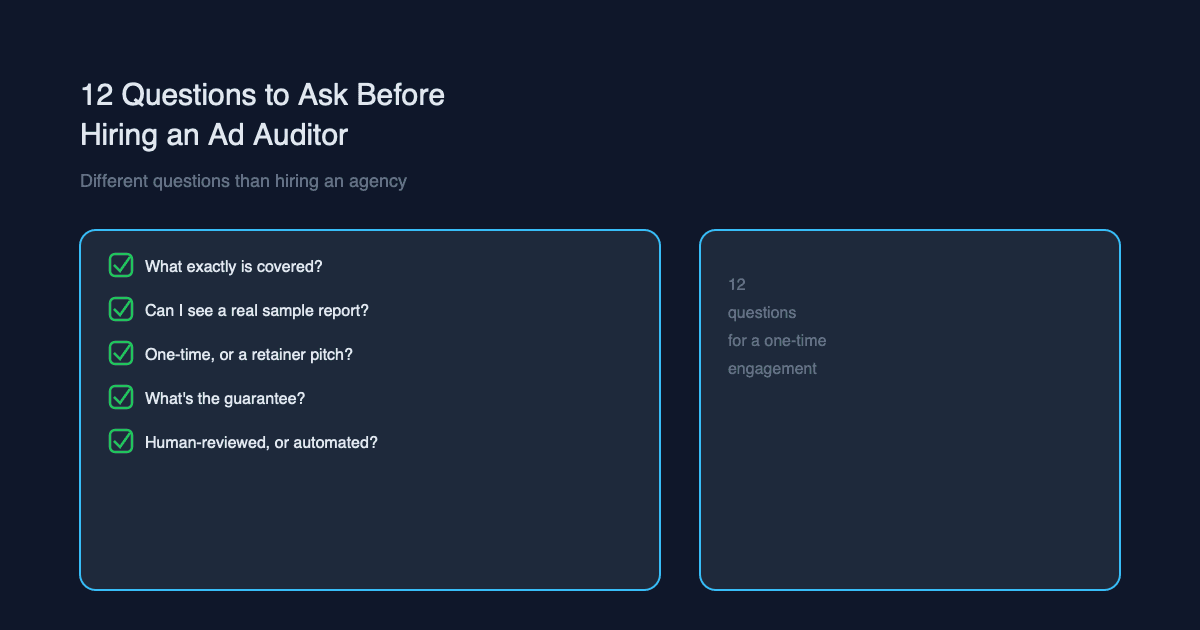
12 Questions to Ask Before You Hire an Ad Auditor
Hiring a one-time ad auditor? Ask these 12 questions on scope, turnaround, sample reports, access and guarantees, then send our copy-paste email template.
By Abhilash LR
By Abhilash LR. Last reviewed 19 Oct 2026.
Before you hire an ad auditor, ask about scope, turnaround, a sample report and the guarantee. An ad account audit is a structured review of your Meta and Google accounts that finds wasted spend, tracking gaps and missed opportunities. The 12 questions below help you compare providers fairly.
Disclosure: Coact sells Loupe, a fixed-price ad account audit. It is one option in this category, and I use these same questions on it in the section below.
Key Takeaways
- Ask for scope, turnaround and the guarantee in writing.
- Ask to see a sample report before you pay.
- Check what account access is needed and how you revoke it.
- A badge does not prove the audit is good.
This is a different decision from hiring an ongoing agency. You are not judging a long relationship. You are judging one bounded deliverable. If you are still weighing broader options, our guide to hiring growth help covers that wider choice.
A 2020 Search Engine Journal guide describes audits as the way to find out what an account is really doing (Search Engine Journal, 15 Apr 2020). But an audit is only worth buying if the provider is clear about what you get.
What an Ad Audit Should Cover
Scope decides whether an audit is useful. That same 2020 guide maps the work to tracking, account structure, bidding, search terms and wasted spend, budget, and creative (Search Engine Journal, 15 Apr 2020). If a provider cannot name its areas, it cannot promise coverage.
The Association of National Advertisers makes a similar point for larger agency reviews. It calls for "a clearly defined scope, outlining the marketer's expectations" (ANA agency search guidelines, 11 Aug 2020). The same logic applies to a small audit.
1. What is covered, and how many checks are there?
Ask for the list of areas and the total number of checks. A number alone means little if you cannot see what it counts.
A good answer: a named list of areas plus an exact number of checks.
A weak answer: "a comprehensive, full-funnel review" with no list and no number.
2. Which platforms does the audit cover?
If you run Meta and Google together, you need both reviewed. One platform alone can hide problems between them, such as overlapping conversion counts.
A good answer: both platforms named, with a statement on whether anything is checked across them.
A weak answer: "We mostly do Google, but we can look at Meta too."
3. What is out of scope?
Every audit leaves things out. You want to hear that before you pay, not after the report lands.
A good answer: a plain statement such as "We do not change your campaigns, build creative or monitor the account afterward."
A weak answer: "Nothing, we cover everything." No audit does.
4. Can you send the exclusion list in writing?
A spoken promise is easy to forget, and a written list protects both sides.
A good answer: "Yes, it is in the order confirmation or the proposal."
A weak answer: "We'll sort that out once we get started."
Turnaround and Sample Reports
A fast report is not automatically a good one, and a slow one is not automatically thorough. What matters is that the date is firm and the proof is visible. Ask for both before any money moves.
5. What is the turnaround in business days, and when does the clock start?
"Soon" is not a deadline. The start trigger matters as much as the number, because a clock that starts only after a long back-and-forth can double the real wait.
A good answer: "Five business days from the day you grant read access."
A weak answer: "Usually a couple of weeks, depending on the queue."
6. Can I see a sample report?
This is the best single test. A real sample shows how specific the findings are and whether they read like your account or any account. Providers differ on whether a sample is open or gated behind contact details, so ask what you must hand over to see it.
A good answer: a real or anonymized report, with any contact-detail requirement stated upfront.
A weak answer: "We can describe what it looks like on a call."
7. Who does the analysis, and how much is automated?
Software is fast at pulling data. Some audit checks need business context and judgment, and are better handled by humans. Adalysis, a PPC software vendor, makes this point about its own category (Adalysis, 23 Jun 2025). Because it sells automation, the concession carries some weight.
A good answer: a clear split, such as "Tools gather the data. A named analyst writes the recommendations."
A weak answer: "Our proprietary AI does everything."
8. What do I receive, and in what format?
Know the shape of the deliverable before buying. Is it a document, a spreadsheet or a video walkthrough? Is there a priority order?
A good answer: "A PDF with findings ranked by impact, plus a fix list."
A weak answer: "You'll get insights."
Access, Commitment and Cost
This group covers risk. You are handing over account access, trusting a promise and paying a price. Each deserves a direct question.
9. What account access do you need, and how do I revoke it?
Ask for the lowest level that works. Google Ads has Email-only, Billing, Read-only, Standard and Admin roles, and only Admin can give or change access. Read-only "can view campaigns and use planning tools" (Google Ads Help, access levels, accessed 19 Oct 2026). To end access, use the Admin menu, then Access and security, then "Remove access," or "Revoke" for a pending invitation (Google Ads Help, managing access, accessed 19 Oct 2026).
Meta's developer documentation lists Reporting only, General user and Admin tiers for ad accounts (Meta for Developers, accessed 19 Oct 2026). It is API documentation, so use it for the tiers only. Ask the provider to state exactly how Meta access ends, and check it in your own Business Settings afterward.
A good answer: "Read-only on both platforms, and here is how to remove us afterward."
A weak answer: "We need Admin so we can look around."
10. Will a retainer pitch follow?
Some audits are priced to lead into an ongoing engagement. That is not wrong, but ask upfront so you can decide. If the topic matters to you, read our piece on retainer versus performance-based pricing.
A good answer: "No. The audit stands alone, and any follow-up is your choice."
A weak answer: "Most clients continue with us." That tells you nothing about whether the audit stands alone.
11. What are the guarantee terms, in writing?
Get the trigger, the deadline and the remedy. Vague promises like "we stand behind our work" prove little.
In the US, the FTC says a money-back guarantee is not a substitute for substantiation (FTC advertising FAQs, accessed 19 Oct 2026). Its rule on guarantee advertising uses the phrase "refunds the full purchase price of the advertised product" (16 CFR 239.3, accessed 19 Oct 2026). That is US guidance only, so it may not apply to you.
A good answer: "If the report does not meet the stated standard, email within the stated window for a refund."
A weak answer: "We're confident you'll be happy."
12. What is the price, and what drives it?
A flat fee is easy to compare. A scaled fee is fine if the drivers are clear.
A good answer: a fixed price list, or a stated formula, such as one based on ad spend or number of accounts.
A weak answer: "We'll quote after a discovery call," with no range.
Either model can be fair. Judge whether the drivers are stated, not whether the price is flat.
How Do the Strongest and Weakest Answers Compare?
Here is a quick view of five questions. Print it, or paste it into your notes.
| Question | Strong answer | Red flag |
|---|---|---|
| Number of checks | Exact count and named areas | "Comprehensive" with no list |
| Turnaround | Business days and a start condition | "A few weeks" |
| Sample report | Real sample, requirements stated | Description only |
| Access | Read-only plus removal steps | Admin required, no end date |
| Guarantee | Trigger, deadline and remedy in writing | "We stand behind our work" |
| Out of scope | Written exclusion list | "Nothing, we cover everything" |
| Who does the analysis | Named analyst, stated tool split | "Proprietary AI does everything" |
| Price | Fixed list or stated formula | "Quote after discovery call, no range" |
This table is generic and applies to any provider, including Loupe. For more warning signs, see our list of PPC audit red flags.
Copy-Paste Email Template
Send this to every provider on your shortlist. Same questions, same format, easier comparison.
Subject: Questions before I order an ad account audit
Hi, I am considering a one-time audit of my Meta and Google ad accounts. Before I decide, could you answer these in writing?
- What areas are covered, and how many checks in total?
- Which platforms do you review?
- What is out of scope?
- Can you send the exclusion list in writing?
- How many business days to delivery, and what starts the clock?
- Can I see a sample report, and what details do you ask for first?
- Who does the analysis, and what is automated?
- What do I receive, and in what format?
- What access do you need, and how do I remove it afterward?
- Will a retainer pitch follow?
- What are the guarantee terms, in writing?
- What is the price, and what changes it?
Thanks, [Your name]
Free Tools vs Human Review
Free audit tools are a fine first pass. They catch obvious issues quickly and cost nothing. Judgment-heavy checks, such as whether a budget split fits your margins, still tend to need a person. Our list of free Google Ads audit tools shows what each can and cannot do. And if you wonder about timing, see how often to audit Google Ads.
Who a One-Time Audit Does Not Suit
A one-time audit works best when the account has history to review. If you spend very little, have only a few weeks of data, or need someone to build and run campaigns, a diagnosis will not help much. Fix conversion tracking first if it is broken. If your ads are profitable but not growing, or DIY has stopped working, those guides may fit better.
Closing Takeaway: What to Do Before You Buy
Send the email template to two or three providers. Compare scope, turnaround, the sample report and the guarantee side by side. Grant the lowest access level that works, and know how to remove it. Pick the one whose answers are specific, written and checkable.
Get Your Account Audited
This section is what Loupe's page says on each question, as of 19 Oct 2026. Where it states nothing, I say so rather than guess; confirm those points with Coact before ordering.
- Coverage and checks (1): a 133-point review. List of areas: not stated here.
- Platforms (2): Meta and Google ad accounts.
- Out of scope (3, 4): not stated here. Whether there is a written exclusion list: not stated here either.
- Turnaround (5): reports in 3, 5 or 7 business days. Start condition: not stated here.
- Sample report (6): a sample report is offered on the Loupe page. It asks for your name, email and phone.
- Who does the analysis (7): not stated here.
- What you receive (8): a report. Format: not stated here.
- Access (9): not stated here.
- Retainer (10): no retainer and no sales calls.
- Guarantee (11): a refund of the audit fee if the review does not surface at least three fixes you can act on that week, requested within 14 days of delivery. Who decides whether that standard was met: not stated here.
- Price (12): US$199, US$299 or US$399. Which tier maps to which turnaround, and what drives the price: not stated here.
Loupe is built for D2C and e-commerce teams spending about Rs 2.5 lakh (US$3,000) or more a month with 60+ days of data. Loupe is not the right fit if you spend under about Rs 2.5 lakh (US$3,000) a month, or have under 60 days of data. Ask the same 12 questions of any other provider, including us.
Still Launching? Get an Expert Team to Execute
If you need execution, not a diagnosis: this is separate from Loupe, which the page describes as having no sales calls. An audit reviews an account that already has data. If you are still launching, or you would rather have a team plan and run the work, book a strategy call with Coact.
Frequently Asked Questions
Does a Google Partner or Meta Business Partner badge mean the audit is good?
No. Google's Partner and Premier Partner criteria concern agency spend, optimization score and certification (Google Ads Help, accessed 19 Oct 2026). None of that certifies audit quality, which is our inference. Google says a badge must not imply it endorses a company's services (badge guidelines, accessed 19 Oct 2026), and you can check badge status yourself. Meta says its badge shows you are "among the best at what you do" (Meta Business Partners, accessed 19 Oct 2026). That is a marketing claim, not an audit certification.
Is a cheaper audit always worse?
Not always. Price reflects positioning as well as quality. Judge quality with scope, sample, turnaround and guarantee. A low price with a vague scope is risky. A fair price with written terms and a real sample is easier to trust.
Does a money-back guarantee prove the audit is good?
No. US FTC guidance says a money-back guarantee is not a substitute for substantiation. A guarantee reduces your risk but does not show quality. Read the trigger, deadline and remedy, then pair it with a sample report.
Disclosure: Coact sells Loupe and earns revenue if you buy it. Loupe's answers appear in one labelled section. The 12 questions apply equally to every provider, including us.
Abhilash LR leads growth marketing at Coact, a performance marketing agency working across Southeast Asia and India. Coact also sells Loupe, a fixed-price ad account audit.
Published at www.coact.biz2026-09-30 · Abhilash LRWant results like these for your brand?
COACT runs performance-based growth across SEA & India. Start with a free 15-day pilot.
Book a strategy callKeep reading
Creative Testing Spreadsheet: Formulas and Stop Rule
A Google Sheets layout, copy-and-paste formulas and a z-test stop rule for Meta and Google tests. In our worked example, a 23% lift was not significant at 95%.
How to Read Meta Ads Manager Without Fooling Yourself
Ads Manager and your store rarely agree. See why Meta's purchase count and your orders differ, plus a monthly reconciliation template and four checks.