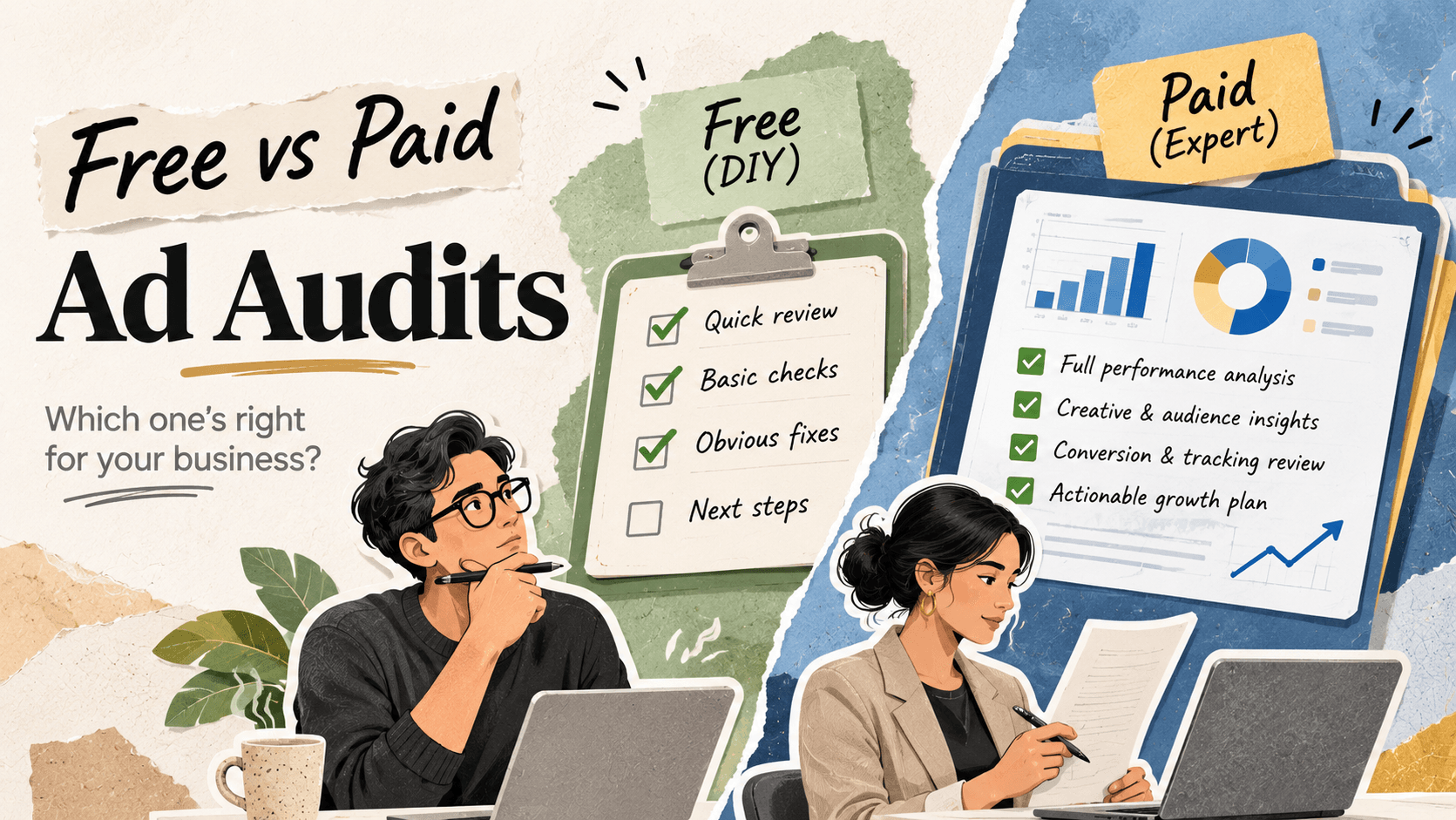
Free vs Paid Ad Audits: What Each One Really Catches
A free ad audit tool checks settings; a paid ad audit judges fit. See which checks are mechanical, which need a person, and when paying for one is worth it.
By Abhilash LR
Open a free ad audit tool and you get a score within minutes. Open a paid audit and you get reasoning about your business. Both have a place, and how much the gap matters depends on how complicated your account has become.
Free tools check whether settings exist and match a fixed rule set, which suits mechanical problems. Paid reviews add a person who reads your account alongside your margins, funnel and other channels, which suits questions of fit. The right choice depends on how complex your account and measurement are.
Disclosure: We sell Loupe, so weigh that when reading this comparison.
Key Takeaways
- Free graders and in-platform recommendations catch mechanical problems fast: disabled campaigns, missing conversion actions, limited budgets.
- Judgement checks need account context: whether a goal, target or budget split fits your business.
- Check the deliverable before paying: does a person review the account, and do you get a written plan, a walkthrough and a way to ask follow-up questions?
- Start free, and pay when scope, measurement or cross-channel questions outgrow what a tool sees.
What Does a Free Ad Audit Catch?
A free ad audit tool is good at finding settings that are missing, broken or out of line with common practice. Free graders and in-platform recommendations read your account data and compare it with a fixed rule set. They flag paused or limited campaigns, absent conversion actions, incomplete ads and obvious budget constraints.
That consistency is a real strength. Rule-based graders apply identical checks to every account, never skip a step, and cost nothing, so you can rerun them after each major change. For a small account with one market and a simple funnel, those mechanical checks may surface most of what's wrong.
Platform recommendations deserve the same reading. Google describes optimization score as an estimate of how well an account is set up to perform, shown alongside its recommendations (Google Ads Help, accessed 2026). It measures setup, not whether the setup suits your margins.
Our roundup of free Google Ads audit tools explains what to expect from them. Treat the output as a to-do list of settings to confirm, and you'll get good value for the price of zero.
Mechanical Checks vs Judgement Checks
Some audit checks are mechanical: the answer sits in a setting, and a tool can read it. Others need judgement: the answer depends on your business, so a person has to weigh it. Flagging a disabled campaign takes a lookup. Deciding whether a conversion action is the right primary goal takes an understanding of what your business counts as a sale.
The table sorts common checks by which side they fall on. For tracking background, see our guide to setting up conversion tracking.
| Check | Can a free tool do it? | Why |
|---|---|---|
| Flag disabled, paused or limited campaigns | Yes | The status is a visible account setting |
| Spot a missing conversion action | Yes | The tool can see whether an action exists |
| Find ads or assets that are absent or incomplete | Yes | Completeness can be counted |
| Decide whether a conversion action is the right primary goal | Partly | The tool sees the setting, not what counts as a real sale for you |
| Judge why Meta and Google report different results for the same sales | No | Needs order records and knowledge of how each platform assigns credit |
| Weigh budget between platforms | No | Depends on margins, demand and goals outside either account |
| Check that a Target CPA or ROAS fits your unit economics | No | Needs your margins, which the account doesn't hold |
The pattern is consistent. Mechanical rows have one correct answer, while judgement rows have several defensible ones, and the right pick depends on facts outside the ad account.
The primary-goal row shows why. In Google Ads, primary conversion actions appear in the "Conversions" column and can drive bidding, while secondary actions are observation-only (Google Ads Help, accessed 2026). A tool can see which label an action carries. It can't tell whether that action deserves the label.
Counting method works the same way. "Every" counts each conversion after an ad interaction, while "One" counts at most one per click (Google Ads Help, accessed 2026). Which suits a store with repeat purchases is a business question.
What Does a Paid Ad Audit Add?
Human judgement about whether your settings suit your business is what a paid review adds. A reviewer reads the account next to information a tool can't see: your margins, your sales cycle, your store or CRM records, and the other platforms you advertise on. Paid audit prices vary widely, and so do scope and depth.
That means the label alone tells you little. Ask practical questions instead. Does a person review the account, or does software scan it? Do you receive a score, a written plan, or a recorded walkthrough? Can you ask questions afterwards?
Our list of questions to ask before hiring an ad auditor covers these in detail. In our experience, the value of a paid ad audit sits in the prioritised reasoning. A long list of findings with no order of importance is just another report that nobody acts on.
Where Does a Free Ad Audit Tool Run Out of Scope?
These tools run out of scope wherever the right answer depends on context outside the account they read. Rule sets work best on settings with clear good and bad states. Automation-heavy campaign types often give a rule less to check directly, so interpretation matters more. Google's search terms insights, which groups queries into intent-based categories and supports Performance Max, is one place that reading happens (Google Ads Help, accessed 2026). Our guide to auditing Performance Max campaigns shows what that review involves.
Cross-channel questions are the other gap. A tool connected to one platform sees one platform's story, so it can't tell you that Meta and Google are both claiming the same sale. Spotting that means comparing platform totals against real orders, which is the subject of our post on attribution and measurement.
Here's a hypothetical example, not a client case. A store records 100 orders in its own system. Meta Ads Manager reports 70 purchases and Google Ads reports 60. Together they claim 130 for 100 real orders, because some customers saw a Meta ad, then clicked a Google ad before buying. Each platform's own audit would call its numbers fine.
Duplicate counting can also come from setup. Meta can only deduplicate Pixel and server events when the event IDs and event names match, and only within 48 hours of the first event (Meta for Developers, accessed 2026). Analytics adds a third view: GA4 offers three attribution models, and data-driven attribution assigns credit using the property's own data (Analytics Help, accessed 2026). Reconciling all of these against orders is judgement work.
Does that make free tools weak? No. They answer "are my settings sound?" very well, and "are my choices right?" poorly.
Where Free Tools and Paid Audits Have Conflicts of Interest
Some free audit tools come from companies that also sell software or services, and in-platform recommendations come from platforms that earn when advertisers spend. That doesn't make the settings checks wrong, since a missing conversion action is missing whoever reports it. It does mean you should read suggestions with your own targets in mind.
Paid audits carry their own version of this. An agency audit can double as the first step of a sales conversation about ongoing management. Neither route is dishonest by default, but the incentives differ.
A useful test applies to both: ask what the provider gains if you follow each recommendation. Then check whether the audit is a standalone deliverable with a defined scope or a lead-in to something else.
When Does the Gap Between Free and Paid Start to Matter?
The gap between a free ad audit and a paid one starts to matter when your account has more moving parts than a rule set can weigh. Several markets with different currencies and customer behaviour are one trigger. Two or more platforms that must agree on the same sales data are another.
Other signs include a bidding target nobody has revisited, a plan to raise budgets sharply, and a free report that leaves you with more questions than answers. When that last one happens, you've probably reached the judgement layer.
Teams also hit the point where nobody has time to work through a long checklist properly. Our piece on when DIY stops working describes that moment. If you'd rather keep going alone, the walkthrough on how to audit a Google Ads account is a solid manual route.
Free vs Paid Ad Audits Side by Side
The two options differ mainly in who does the reading and how much context they bring. Cost, depth and output format follow from that. The table below summarises the differences without ranking either option as better, because each wins on a different question.
| Factor | Free ad audit tool | Paid ad audit |
|---|---|---|
| Cost | Free | Varies widely by provider and scope |
| Reviewer | Automated rule set | A person, sometimes assisted by tools |
| Output | Score and flagged settings | Ranges from a basic report to a written plan with a walkthrough |
| Strong at | Mechanical settings, repeat checks after changes | Fit, measurement, cross-channel priorities |
| Weak at | Business context, margins, attribution disputes | Cost and waiting time; quality differs by provider |
| One fixed-price example | n/a | Loupe by COACT: one-time, US$199 to US$399, 133-point human-reviewed framework |
Read the "weak at" row as honestly as the "strong at" row. A paid ad audit costs money and takes days, and not every provider delivers reasoning worth the fee.
Which Should You Use?
Use a free ad audit tool first for mechanical settings, and pay for a review when scope, measurement or cross-channel questions exceed what a tool can see. The free pass costs nothing and clears the obvious problems, so a paid reviewer's time goes to questions that need a human.
Our ad account audit framework shows the order that works: measurement first, then each platform, then how they interact. A free tool covers part of the early steps. The later ones, especially judging how Meta and Google results fit together, are where a person earns their fee.
- Run the free pass. Use a grader or in-platform recommendations this week and save the output.
- Fix what it flags. Resolve the mechanical items, then rerun to confirm they cleared.
- Decide on paid. If open questions remain that the account alone can't answer, such as margins, targets or platform disagreement, that's your signal to pay for a proper review.
Frequently Asked Questions
Should I run a free ad audit before paying for one?
Yes, because a free pass clears the obvious problems at no cost. Do it first, fix whatever it flags, and then judge what questions remain. A paid reviewer can then spend their time on the harder issues.
Are free ad audit tools accurate?
Free ad audit tools are reliable for what they read directly, such as campaign status, conversion action presence and basic completeness. Accuracy is a different matter for questions of fit. A tool can confirm a target exists but can't confirm it matches your margins.
Can a free tool check whether my conversion tracking is right?
Only partly. A free tool can see whether conversion actions exist and are active, but it can't tell whether they match real orders. Checking that means comparing platform numbers with your store or CRM records.
Is a paid ad audit always worth the money?
No. A small, single-market account with a simple funnel may get most of the value from a free tool plus a manual checklist. Paid reviews pay off as complexity grows, or when a wrong decision would be expensive.
How do I tell a real paid audit from a sales pitch?
Look at the deliverable. Look for a defined scope, a named output such as a written plan, and a price that doesn't depend on signing a retainer. If the "audit" is mostly a meeting, treat it as a pitch.
How often should I rerun a free audit tool?
After any significant change, such as new campaigns, a tracking update or a budget increase, and on a regular schedule between those. Because the tool costs nothing, there's little reason to wait.
Get Your Account Audited
Loupe by COACT is a one-time Meta and Google Ads account audit built on a 133-point review framework. Single platform uses the relevant subset; Meta + Google covers all 133; Full funnel adds extras. People at COACT review the account, with tools assisting, rather than running an automated scan. Every audit includes a written prioritised plan, a recorded video walkthrough and 30 days of implementation Q&A. Loupe doesn't edit, pause or create campaigns, and no sales call is required. It's built for D2C and e-commerce teams spending roughly US$3,000 a month (INR 2.5 lakh) or more, with 60+ days of data.
Single platform costs US$199 (Meta or Google, report in 3 business days). Meta + Google costs US$299 and Full funnel costs US$399, both delivered in 7 business days; Full funnel adds a TikTok review, up to three agreed landing or funnel pages, a competitor creative scan and a 60-minute live walkthrough. The delivery clock starts after complete intake and access are confirmed. Payment is one-time, with no retainer. If the report lacks at least three specific, actionable recommendations within your purchased scope, you can request a refund within 14 days of delivery. That's an actionability guarantee, not a ROAS or revenue guarantee. See the Loupe page for details and a free sample report.
Abhilash LR is the founder of COACT, a growth-focused agency operating across India, Southeast Asia and Singapore. He has spent a decade working with startups and scaleups, where he kept seeing the same problems: businesses leaving growth on the table because of the wrong partners, systems, strategy and incomplete data loops. COACT is built on the principles he works by: performance-driven, founder-obsessed, and focused on what actually moves the needle. COACT also sells Loupe, a fixed-price ad account audit. Questions or corrections: contact us. Learn more about COACT.
Published at www.coact.biz2026-09-30 · Abhilash LRWant results like these for your brand?
COACT runs performance-based growth across SEA & India. Start with a free 15-day pilot.
Book a strategy callKeep reading
Audit Findings: What to Do With Them, Step by Step
Turn audit findings into fixes in five steps, tracking first. Get an impact and effort table and learn how to judge a fix after Google's 7-day learning window.
Ad Account Audit: Do It In-House or Hire Someone?
Audit your ad account yourself or hire out? Use a 3-question test and a hybrid workflow, or a US$199 fixed-fee audit as a starting point if you need help.