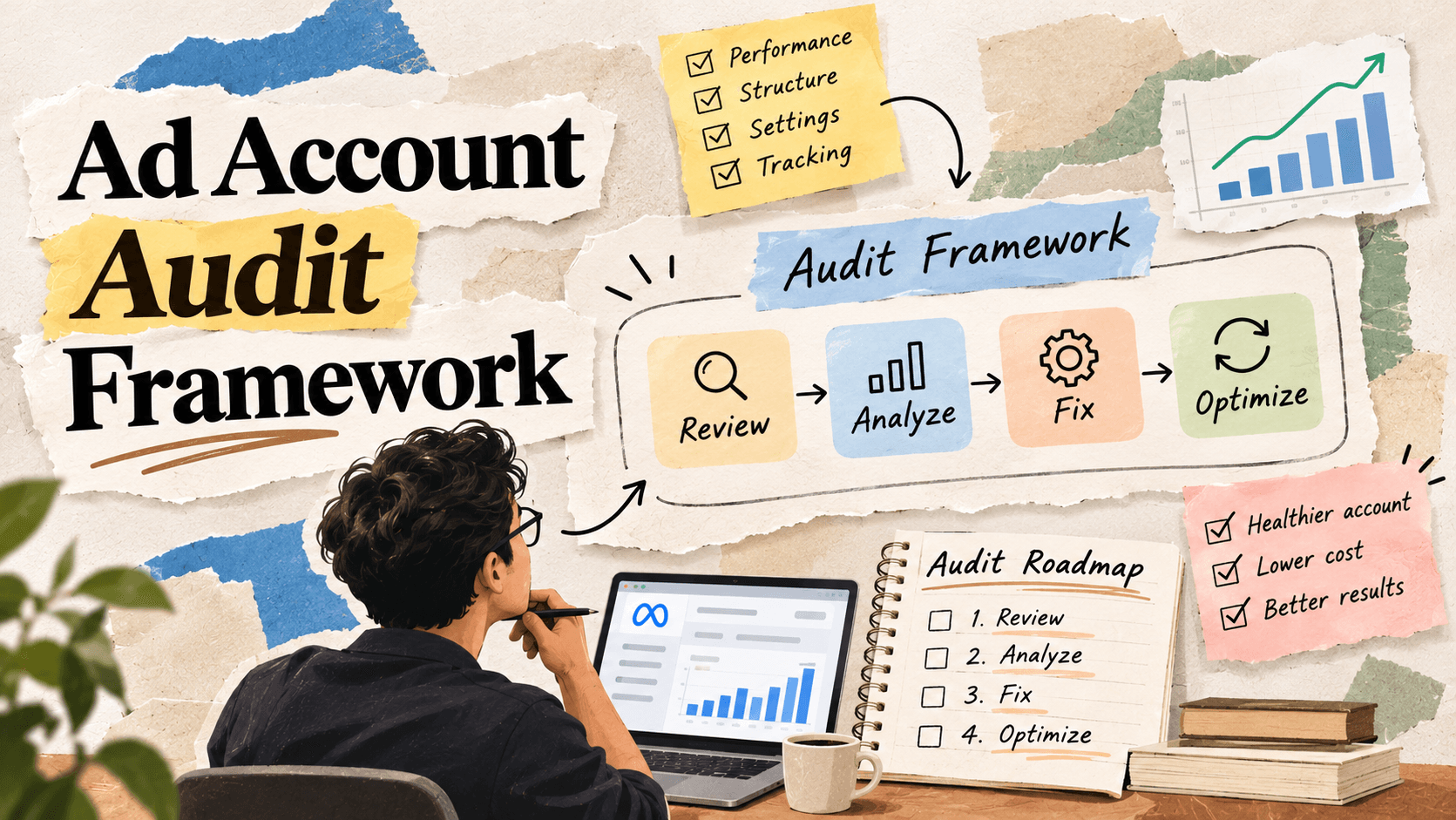
Ad Account Audit Framework: The 133 Points We Check
Our 133-point ad account audit framework runs five categories in a fixed order, from measurement to post-click, so you fix the right things first.
By Abhilash LR
Most audits fail on sequence, not coverage: they judge bids and creative before checking that the conversion data is right. This framework runs five categories in a fixed order: measurement first, then each platform, then how they interact, then what happens after someone clicks.
It contains 133 checks. This post sets out the five categories, their order, and the main checks in each, so you can work through the structure on your own account. The full 133-point review is what Loupe by COACT, our paid Meta and Google Ads audit, runs.
Key Takeaways
- Five categories, in order: measurement, Meta Ads, Google Ads, cross-channel, and the post-click journey, 133 checks in total.
- Order matters. Judging bidding or creative before verifying measurement means grading decisions against numbers that may be wrong.
- Cross-channel means failures neither platform can see alone, such as Meta and Google both claiming the same sale.
- Triage in the same order you audit: fix measurement first.
Why Does an Ad Account Audit Run in a Fixed Order?
An ad account audit should run in a fixed order because each category depends on the one before it. Platform findings are only trustworthy once measurement is verified, and cross-channel problems only show up after both platforms are understood. Reversing the order produces confident conclusions built on unreliable data.
Think about what happens otherwise. You open Google Ads, see a campaign with a strong cost per acquisition, and decide to scale it. But if the conversion tag fires twice per purchase, that "strong" result is half as good as it looks. You've graded the campaign against the wrong answer key.
That's why measurement sits at the start. The same logic applies further down the chain. Cross-channel checks need clean platform data to compare. Post-click checks need to know which traffic is actually worth sending to the page. Each step earns the right to run the next one.
What Are the Five Parts of an Ad Account Audit?
The five parts of an ad account audit are measurement and data integrity, Meta Ads, Google Ads, cross-channel priorities, and the post-click journey. Each part has its own named checks. Below, every category opens with a short summary, then lists the specific items we review.
1. Measurement and Data Integrity
Your conversion data has to be trustworthy before anything else can be judged. If tags misfire, events double count, or attribution windows ignore your real sales cycle, every later finding rests on bad numbers. That's why this category comes first.
- Pixel and tag firing: each tag fires once, on the right action, with the right value.
- Event deduplication: browser and server events share the same event ID and event name, so one purchase counts once (Meta for Developers, handling duplicate events).
- Conversion action settings: primary versus secondary actions, count method, and assigned values. Only primary actions feed the Conversions column and bidding (Google Ads Help).
- Attribution windows: do they match how long customers actually take to buy?
- Server-side connections: Conversions API or Enhanced Conversions are sending data, not just switched on.
For setup detail, see our guide on how to set up conversion tracking. For the bigger picture, read attribution and measurement.
2. Meta Ads
Meta's delivery system can only optimise what it can see. This category tests the signal going in and the creative variety behind it. Strong targeting can't rescue weak events or tired ads, so we also look at how budget and creative are spread across the account.
- Event Match Quality: reviewed per event, not as a single account-level impression.
- Creative fatigue signals: rising frequency, falling click-through rate, and ads running far past their useful life.
- Creative variety: enough genuinely different concepts for the spend level.
- Learning-phase stability: frequent edits that keep ad sets from settling.
- Audience overlap: ad sets competing against each other for the same people.
- Budget distribution: spend concentrated where results justify it.
If fatigue is your main concern, our post on ad fatigue in Meta covers the warning signs.
3. Google Ads
Automated bidding chases whatever target you set. These checks test that target, the budget behind it, and the queries it spends on. Search traffic leaks money quietly, so the review covers both the settings and the search terms they produce.
- Bidding strategy fit: whether the chosen strategy suits the conversion volume available.
- Target realism: whether your Target CPA or ROAS still reflects your real unit economics.
- Search-terms waste: irrelevant queries consuming spend, and negative keyword coverage.
- Geo-targeting and network settings: defaults that quietly widen reach.
- Campaign overlap: different campaign types bidding on the same queries.
- Keyword-level Quality Score: weak ad relevance or landing page experience.
Our list of PPC audit red flags pairs well with this category.
4. Cross-Channel Priorities
Cross-channel priorities cover failure modes that only exist between platforms, not inside either one. The classic case is Meta and Google both claiming credit for the same sale. Each platform's reporting looks reasonable on its own, so a platform-by-platform review misses it.
- Overlapping credit: the sum of platform-reported conversions versus actual orders or leads.
- Budget split logic: whether spend is allocated by evidence or by habit.
- Conversion definitions: the same event meaning the same thing on both platforms.
- Source-of-truth comparison: platform totals reconciled against store, CRM, or analytics records.
- Demand capture: whether branded search is getting credit for demand other channels created.
Differences in how platforms assign credit are explained in attribution models explained.
5. The Post-Click Journey
The click is only half the job. This category follows the visitor onto the page. To a visitor, the ad and landing page are one experience, even though they live in different tools. A good ad can't compensate for a page that breaks its promise or loads slowly on a phone.
- Message match: headline, offer, and imagery on the page match the ad.
- Mobile load speed and rendering: the page works properly on a real phone.
- Form and checkout friction: unnecessary fields, steps, or errors.
- Parameter continuity: tracking parameters survive redirects and reach your analytics.
- Offer consistency: price, terms, and calls to action agree from ad to confirmation page.
| Category | What it catches | Depends on |
|---|---|---|
| 1. Measurement | Wrong signals feeding every downstream decision | Nothing, this comes first |
| 2. Meta Ads | Weak event quality, creative fatigue, learning-phase churn | Category 1 |
| 3. Google Ads | Stale bidding targets, search-terms waste, Quality Score issues | Category 1 |
| 4. Cross-channel | Double-counted conversions, illogical budget splits | Categories 1 to 3 |
| 5. Post-click | Ad promise not matching landing page reality | All of the above |
Double Counting in Practice: A Worked Example
Double counting happens when two platforms each report credit for the same purchase, so their combined total exceeds what your store recorded. It's the clearest cross-channel failure, and a simple comparison against real orders exposes it quickly.
Illustrative example (not a client result): over one month, Meta reports 100 purchases and Google Ads reports 80. Your store records 120 orders. The platforms claim 180 purchases between them, but only 120 happened. So at least 60 orders were credited to both.
Neither platform is lying. Each measures from its own touchpoints and counts a sale if its ad was involved. The problem starts when you read each report separately and conclude both channels are performing well. Budget decisions made from those numbers will favour whichever platform claims more, not whichever one drove more.
You can run this check yourself. Export 30 days of platform-reported purchases from each platform, add them up, and subtract your store's order count. Anything above zero is credit claimed twice or credit with no matching order.
One pattern we see often when we review accounts is that the attribution setup is broken, and the cause is usually that the business measures success differently from how the ad platforms do. The north star metric is not the same for every business. For a purely online business, it can be an online conversion. For a business with an offline touchpoint as well, such as a store visit, a sales call or a demo that closes later, the question becomes harder: how do you calculate return on investment, and how do you attribute those offline events back to your online spend?
When there is no clear answer, the ad platforms only see the online part of the journey. Campaigns end up with no clear view of real performance, and part of the budget quietly leaks into spend nobody can tie to a result. That is why the framework puts measurement first, and why the first step is agreeing on what counts as a conversion for your business before you judge any campaign against it.
Read Audit Results in the Order You Ran Them
Read audit results in the same order the audit runs: measurement, platform fixes, cross-channel, then post-click. Fixing a creative issue before a tracking issue wastes effort, because you can't tell whether the creative fix worked. Sequence your actions so each one can be measured.
- Measurement first. Broken or duplicated conversion data blocks every other decision. Fix it before touching budgets or bids.
- Platform fixes second. Handle Meta and Google issues next, starting with whatever wastes the most spend.
- Cross-channel third. Once platform data is trustworthy, reconcile it against real orders and adjust the budget split.
- Post-click last. Improve landing pages and forms once you know which traffic is worth sending to them.
Within each tier, rank findings by two questions. How much money does this affect? How quickly can it be fixed? Cheap, high-impact fixes go first. If you're unsure how to interpret what the platforms show you, our guide to reading Ads Manager is a useful companion.
When Should You Run an Ad Account Audit?
Run an ad account audit before you scale spend and after any tracking or platform change. Those are the moments when hidden problems become expensive. Scaling a flawed account multiplies the waste, and a changed setup can silently break measurement.
Good triggers include:
- Before raising budgets, so you scale something that works.
- After a tracking change, such as a new tag setup, a site migration, or a checkout rebuild.
- After a platform change, when a bidding option, campaign type, or measurement setting is altered.
- When results shift without an obvious cause.
Trigger-based beats calendar-based: audit before you raise budgets and after any tracking change. If you want a default, how often to audit Google Ads covers cadence. And if budget increases are on your mind, read why scaling budget breaks ROAS first.
What Does an Ad Account Audit Not Cover?
An ad account audit does not cover your product, pricing, or market, and it can't promise results. It reviews how your accounts are set up and measured. It tells you what to fix, not whether your offer is strong enough to win.
Be realistic about these limits:
- It reviews setup, not strategy at the business level. Positioning and pricing sit outside it.
- It can't create demand that doesn't exist for your offer.
- It doesn't execute the fixes. You or your team apply them.
- It covers Meta and Google Ads. Other channels aren't part of this framework.
- It's a snapshot. Accounts change, so findings reflect the account as reviewed.
Being clear about this keeps expectations honest. An audit narrows the list of things worth changing. It doesn't replace testing, which is how you learn what resonates once the foundations are sound.
Frequently Asked Questions
Why does measurement come before everything else?
Measurement comes first because every other finding is only as reliable as the data behind it. A bidding strategy that looks efficient against duplicated conversions isn't efficient at all. Verifying tags, events, and attribution first means later conclusions rest on numbers you can trust.
What does cross-channel mean in an ad account audit?
Cross-channel means problems that neither platform's reports can show on their own. The standard example is Meta and Google both claiming the same sale. Another is a budget split nobody deliberately chose. A platform-by-platform review can't see either one.
Is 133 checks too many for a small account?
No, because not every check needs to find something for the full list to be worth running. A simple, single-market account may clear many checks quickly and spend most of its time in measurement. The value lies in not skipping the check that would have mattered.
Can I run this audit myself?
Yes, you can run it yourself, and this article lays out the structure for exactly that purpose. What you trade away is an outside view on ambiguous findings and the time to work through every check. If you go solo, run Meta ads yourself offers useful guidance.
Should I hire someone to audit my account?
Hiring helps when you want an independent view or lack time to do the checks properly. It's not mandatory. Before you commit, read our questions to ask before hiring an ad auditor. Free tools can also help, as covered in free Google Ads audit tools.
Get Your Account Audited
You can use this framework on its own, with or without the paid audit. If you'd rather have it run for you, Loupe by COACT is a one-time Meta and Google Ads account audit built on these 133 points.
You get a 133-point review, a recorded walkthrough, and prioritised fixes. There's no retainer. Pricing is US$199, US$299, or US$399, one-time. Whichever route you choose, start with measurement and work down the list in order.
Abhilash LR is the founder of COACT, a growth-focused agency operating across India, Southeast Asia and Singapore. He has spent a decade working with startups and scaleups, where he kept seeing the same problems: businesses leaving growth on the table because of the wrong partners, systems, strategy and incomplete data loops. COACT is built on the principles he works by: performance-driven, founder-obsessed, and focused on what actually moves the needle. COACT also sells Loupe, a fixed-price ad account audit. Questions or corrections: contact us. Learn more about COACT.
Published at www.coact.biz2026-09-30 · Abhilash LRWant results like these for your brand?
COACT runs performance-based growth across SEA & India. Start with a free 15-day pilot.
Book a strategy callKeep reading
Audit Findings: What to Do With Them, Step by Step
Turn audit findings into fixes in five steps, tracking first. Get an impact and effort table and learn how to judge a fix after Google's 7-day learning window.
Ad Account Audit: Do It In-House or Hire Someone?
Audit your ad account yourself or hire out? Use a 3-question test and a hybrid workflow, or a US$199 fixed-fee audit as a starting point if you need help.