AI-Powered Paid Media Agency Fees for D2C Brands in India
Indian rate cards run ₹1.2-20 lakh a month depending on ad spend. 'AI-powered' isn't a price tier. Here's what to pay, and how much the fee must save you.
By Abhilash LR
A D2C brand in India should expect to pay an agency roughly ₹1.2 lakh to ₹3 lakh a month at ₹5-15 lakh of monthly ad spend, scaling to ₹10-20 lakh at ₹2 crore and above, or about 8-15% of spend. Agency fees are billed on top of your ad budget. No rate card we reviewed prices "AI-powered" as its own tier. Pay for scope and results, then test whether the AI part does anything you couldn't get from the platforms for free.
Key Takeaways
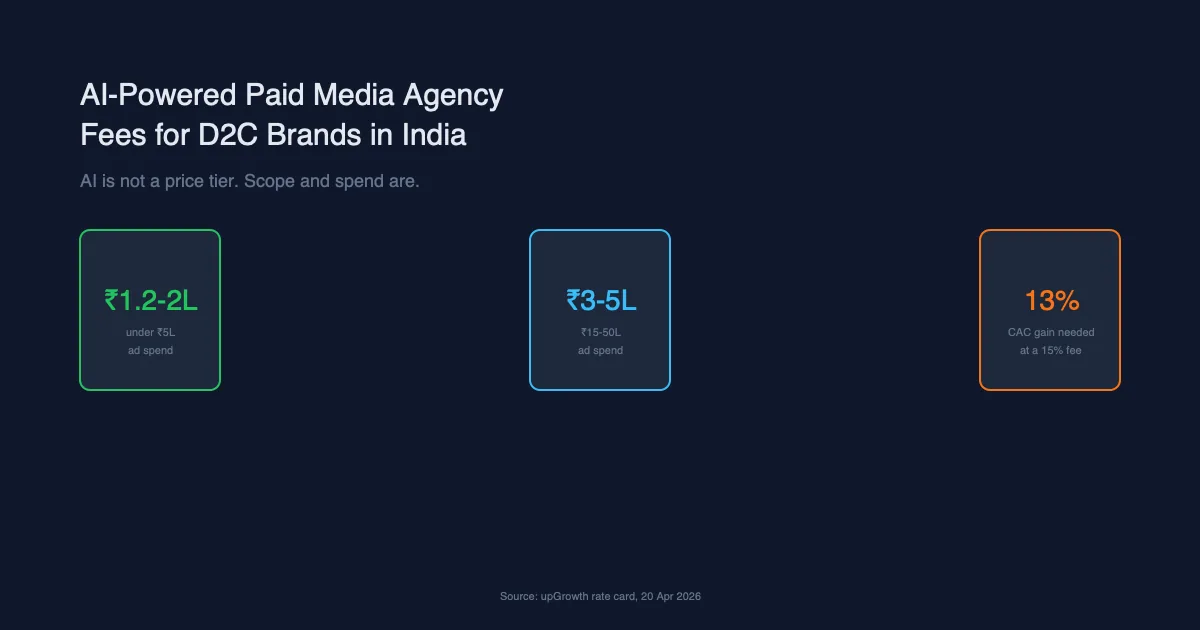
- Fees scale with ad spend, not with the "AI" label. upGrowth's April 2026 rate card lists flat retainers from ₹1.2-2 lakh (under ₹5 lakh of spend) up to ₹10-20 lakh (above ₹2 crore).
- A percentage fee quietly raises your CAC. At a 15% fee, the agency must cut your media CAC by about 13% just to break even.
- Platform AI is free. Meta's Advantage+ and Google's Smart Bidding come with the accounts. An agency should add something above them: measurement, creative volume, or better targets.
- These are seller-published figures. None come from an independent survey.
What Does an Agency Charge a D2C Brand in India?
Published figures cluster by monthly ad spend. upGrowth, an agency, published a 2026 rate card that sets a flat retainer and a hybrid option for each spend band.
| Monthly ad spend | Flat retainer | Hybrid option (floor + share) |
|---|---|---|
| Under ₹5 lakh | ₹1.2-2 lakh | not listed |
| ₹5-15 lakh | ₹2-3 lakh | ₹1.5 lakh + 10% |
| ₹15-50 lakh | ₹3-5 lakh | ₹2 lakh + 12% |
| ₹50 lakh-2 crore | ₹5-10 lakh | ₹3 lakh + 10% |
| Above ₹2 crore | ₹10-20 lakh, negotiated | ₹5 lakh + 8% |
All rows are from upGrowth's card. A second seller, The Shizz, publishes lower percentage bands (8-12% at ₹10-50 lakh, 5-8% above ₹50 lakh) and a boutique retainer range of ₹75,000-₹2.5 lakh. ITD GrowthLabs lists Google Ads and Meta management at ₹40,000-₹3 lakh a month, "indicative, 2026." The sources do not agree, and Zephra's pricing guide notes that all such ranges are "sellers' figures, not surveys" that usually exclude tax, creative production and tools. Add GST, which accounting references put at 18% for marketing services.
What Does "AI-Powered" Actually Add?
It depends on what the agency does that the platforms do not already do for free. Meta's ad-matching engine, Andromeda, was built to strengthen Advantage+ automation. Google's automated bidding now holds budget-limited Target CPA and Target ROAS campaigns to the target you set, which makes the target itself the lever. Both are available to every advertiser at no charge.
So the useful questions are what the agency adds on top. Typical answers:
- Better inputs. Cleaner conversion data, so the platform optimises toward profitable orders and not just any order.
- More creative, tested properly. Volume and genuine variety, since automated systems can only choose among ads that exist.
- Targets tied to your margin. A bidding target that reflects contribution margin, revisited as costs change.
- Honest measurement. Reconciling platform-reported revenue with your orders. Our guide to measuring marketing ROI explains why this matters.
If you want to test an agency's claims, our companion post on how to vet an AI marketing agency in India lists what to ask for.
How Much Must the Fee Save You?
For a D2C brand, the fee is part of your acquisition cost. Fully loaded CAC is (media + fee) ÷ new customers, so a percentage fee has to be earned back before it helps.
| Fee as a % of media spend | CAC improvement needed to break even |
|---|---|
| 8% | 7.4% |
| 10% | 9.1% |
| 12% | 10.7% |
| 15% | 13.0% |
| 20% | 16.7% |
The formula is fee ÷ (media + fee). It is plain arithmetic, not a benchmark. If an agency cannot show how it will lower your media CAC by at least that much, the fee is a cost, not an investment. For ways to lower CAC itself, see how to lower CAC for D2C brands.
Retainer, Percentage or Performance-Linked?
- Flat retainer. Predictable and easy to budget. Fits a well-defined scope at modest spend.
- Percentage of spend. Scales with your budget, but rewards spend, not profit.
- Hybrid. A floor plus a share. Common once spend passes a few lakh a month.
- Performance-linked. Part of the fee depends on ROAS, CAC or qualified leads. It needs a precise contract. Our posts on retainer versus performance-based pricing and the contract checklist for ROAS and CPA deals cover the details.
How COACT Prices It
COACT is a performance-based growth agency with teams in Bangalore and Mumbai and offices in Singapore and Jakarta. Its stated model ties a meaningful portion of the fee to outcomes such as ROAS and qualified leads, rather than a retainer paid regardless of results. COACT does not publish fee amounts, so terms are scoped on a call. See its India performance marketing offer for scope, and note that new clients can start with a free 15-day pilot.
Want a Fee Tied to Your Results?
If you would rather share the risk than pay a retainer for effort, book a free strategy call with COACT. Bring your monthly ad spend, current CAC and target ROAS, and you will get a view on what a sensible fee structure looks like for your numbers.
Frequently Asked Questions
Is ad spend included in these agency fees?
No. Agency fees are billed separately from the ad budget you pay directly to platforms such as Meta and Google. Confirm billing arrangements in writing, including who owns the ad accounts.
Does "AI-powered" mean I should pay a premium?
Not on its own. The rate cards we reviewed price by scope and ad spend, not by AI use. Ask what the AI actually does, such as creative iteration, bidding targets or measurement, and whether you could get the same result from the platform's built-in automation.
When does a percentage fee beat a flat retainer?
Below a certain spend the percentage is cheaper, and above it the flat fee is. For example, a ₹1.5 lakh retainer equals 12% of ₹12.5 lakh of monthly spend. Percentage fees also move with your budget, so ask how they step down as you scale.
What is a realistic minimum fee for a small D2C brand?
Published floors start around ₹40,000 a month for narrow scopes and ₹1.2 lakh for a managed programme, depending on the seller. The right floor depends on channel mix and service depth, so ask for scope-matched proposals rather than single-number quotes.
How should I compare proposals from different agencies?
Compare what is included (channels, creative cadence, attribution, reporting), the pricing model, and the expected deliverables. Ask which AI tools are used and for what, and request a short pilot before a long contract.
Can a performance-linked fee actually lower my CAC?
It can align incentives, but only if the metric, the data source and the exclusions are defined precisely. Without that, disputes over attribution and returns tend to follow. Define the formula in the contract before work starts.
Sources and method: Rate figures are seller-published, read directly on 8 October 2026: upGrowth's rate card (20 April 2026), The Shizz (4 September 2026) and ITD GrowthLabs, with Zephra's guide noting that they are not surveys. The Andromeda reference is Meta's own engineering post; the bidding change is from Google Ads Help. COACT details are from COACT's own site.
Abhilash LR leads growth marketing at Coact, working with performance and D2C brands across India, Singapore, and Indonesia.
Want results like these for your brand?
COACT runs performance-based growth across SEA & India. Start with a free 15-day pilot.
Book a strategy callKeep reading
Ecommerce Conversion Rate India, Indonesia: What Vendors Say
Vendors put India's D2C conversion rate at 1.5-2.5% and Indonesia at 0.8-2.4%. See why the figures conflict and how to measure your own from store orders.
Southeast Asia CAC Benchmarks 2026: What Data Exists
Singapore's median Meta CPC is near the global median (SGD 1.00 vs 1.04); the Philippines' is 93% lower. No SEA CAC-by-industry study exists; see the data.