Performance Marketing Contract Checklist (ROAS/CPA, India)
Before signing a ROAS or CPA-linked agency contract in India, define the metric, data source, refunds, GST and exit terms. A worked example shows why.
By Abhilash LR
Before you sign with an agency that charges on ROAS or CPA targets, the contract must let both sides calculate the same number from the same data. That means writing down the exact formula, the data source that governs billing, which revenue counts, which spend counts, how refunds, taxes and fraud are treated, and how either party exits. Most disputes come from ambiguity in those definitions, not from bad faith. This is a business checklist, not legal advice; have counsel review the final contract.
Key Takeaways
- Write the formula, not the label. "ROAS" can mean gross or net, platform-reported or order-system revenue. Each choice can flip whether a target was hit.
- Name the source of truth. Platform dashboards and your order system will differ. The contract should say which one governs the invoice.
- List the India-specific exclusions. COD refusals, return-to-origin (RTO) shipments, refunds and GST all change the number.
- Keep ownership. You own the ad accounts, pixels, audiences and data, before and after the contract.
Why Does the Definition Matter So Much?
Consider an illustrative month. The numbers are invented to show the mechanics.
| Item | Amount |
|---|---|
| Revenue the ad platform reports | ₹12,00,000 |
| Less refunds, cancellations and RTO | ₹1,80,000 |
| Net revenue per your order system | ₹10,20,000 |
| Eligible ad spend | ₹3,00,000 |
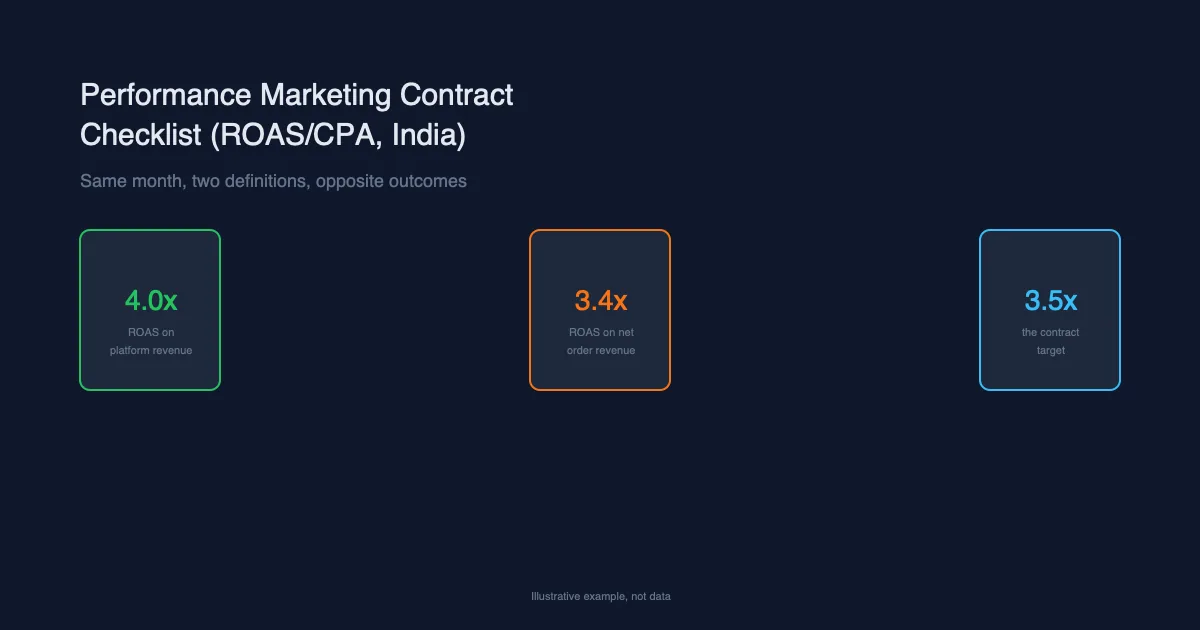
| ROAS on platform revenue | 4.0x |
| ROAS on net order revenue | 3.4x |
If the contract target is 3.5x, the agency has hit it on one definition and missed it on the other. The fee changes, and so does the argument. A precise definition removes it.
What Should the Contract Define?
The metric
- ROAS formula. Write it as attributed revenue divided by eligible ad spend, then define both terms.
- CPA qualifying action. A sale, a submitted lead, a qualified lead or a booked appointment, with objective qualification criteria.
- Currency, rounding and calculation period for each target.
The data source
- Which source governs billing: platform reports, CRM, or the Shopify or backend order system.
- How platform and order data are reconciled each month, and who prepares that report.
- The attribution model and window, such as last click or seven-day click, and whether view-through is counted.
Revenue and spend
- Gross or net revenue, and whether refunds, cancellations, chargebacks and COD refusals are deducted.
- Which spend counts: Google and Meta only, or all channels, and whether agency fees are included.
- Whether revenue counts when it is invoiced or when it is collected.
What Should a CPA Deal Add?
If you pay per lead or acquisition, define quality up front.
- How duplicates, spam, fraudulent leads and existing customers are treated.
- Lead qualification steps, the rejection window and the evidence required to reject a lead.
- The delivery format and tracking fields: UTM, timestamp and a unique ID.
Fees, Caps and Payment
| Clause | What to specify |
|---|---|
| Fee formula | How the fee is tied to the metric, including any minimum, cap or banded rate |
| Fixed component | Whether a retainer or kickoff fee sits alongside the performance fee |
| Billing | Frequency, currency, due dates and proration for partial months |
| GST | Whether quoted fees include GST. Accounting references put GST on marketing services at 18%; confirm with your CA |
| Ad spend | Paid directly to platforms, or through the agency, and any mark-up |
For the trade-offs of each fee design, see retainer vs performance-based pricing.
Ownership, Access and Exit
- You retain ownership of ad accounts, pixels, tags, audiences, creative and first-party data.
- You hold admin access to Google Ads and Meta Business Manager; the agency is granted access, not the other way round.
- On termination: a handover checklist, a transfer timeline, data export formats and data deletion or return. If the contract involves personal data, ask your counsel how India's Digital Personal Data Protection Act, 2023 applies to the arrangement.
- A dispute window with a concrete timeline, an escalation path, and a right to audit raw data if reports cannot settle it.
What Edge Cases Should Be Listed?
- Platform events. Outages, spend freezes and policy bans, and who bears the impact on targets.
- Fraud and invalid traffic. How it is detected and subtracted.
- Exclusions. Existing customers and prior leads, returns, chargebacks and cancellations.
- Sample calculations. Attach two worked examples so both parties see the same arithmetic.
If you are unsure your tracking can support a contract at all, Loupe checks measurement integrity as the first of its 133 audit points, with a report in 3-7 business days and no retainer.
When to Involve a Lawyer or CA
Get a legal or accounting review if the metric language is ambiguous, the financial exposure is large, or the tax treatment is complex. If attribution disputes are likely, consider an independent measurement clause. For what to ask before shortlisting an agency, see 12 questions to ask before hiring a growth agency.
Want a Contract You Can Actually Calculate?
COACT ties a meaningful portion of its fee to results such as ROAS and qualified leads, and says it avoids long lock-ins. If you want to walk through how those terms would be defined for your account, book a free strategy call with COACT. A free 15-day pilot is available before any long-term commitment.
Frequently Asked Questions
Should ROAS or CPA be based on platform reports or my CRM?
The contract should name one source as governing the invoice. Many disputes arise because platform-reported revenue differs from order-system revenue, so also specify the reconciliation process and what happens when the two disagree.
How should refunds and chargebacks be treated?
Say whether revenue is counted net of refunds, chargebacks, cancellations and returns, and set a look-back period for adjustments. Define the evidence needed to substantiate each one.
What if I suspect low-quality or fraudulent leads?
Define lead-quality criteria and a rejection procedure in advance, and require access to raw lead data with timestamps. Agree a timeline for disputing and removing invalid leads from the CPA count.
Do I need to address GST in the contract?
Yes. State whether fees and calculations include or exclude GST and who invoices it. Marketing services are generally taxed at 18%, but confirm the treatment for your situation with a CA.
Can I insist on admin access to the ad accounts?
Yes, and you should. Specify the account roles in the contract so that you keep control of ad accounts, pixels and audiences, and state what the agency may and may not change.
Is a performance-linked contract always better than a retainer?
Not automatically. It aligns incentives only if the metric, data and exclusions are precise. A vague performance clause can create more disputes than a clear flat fee.
Sources and method: The GST rate is from accounting-software references such as Busy and should be confirmed against current notifications with a CA. The worked example is illustrative, not data. COACT details are from COACT's own site. This is general information, not legal or tax advice.
Abhilash LR leads growth marketing at Coact, working with performance and D2C brands across India, Singapore, and Indonesia.
Want results like these for your brand?
COACT runs performance-based growth across SEA & India. Start with a free 15-day pilot.
Book a strategy callKeep reading
Ecommerce Conversion Rate India, Indonesia: What Vendors Say
Vendors put India's D2C conversion rate at 1.5-2.5% and Indonesia at 0.8-2.4%. See why the figures conflict and how to measure your own from store orders.
Southeast Asia CAC Benchmarks 2026: What Data Exists
Singapore's median Meta CPC is near the global median (SGD 1.00 vs 1.04); the Philippines' is 93% lower. No SEA CAC-by-industry study exists; see the data.