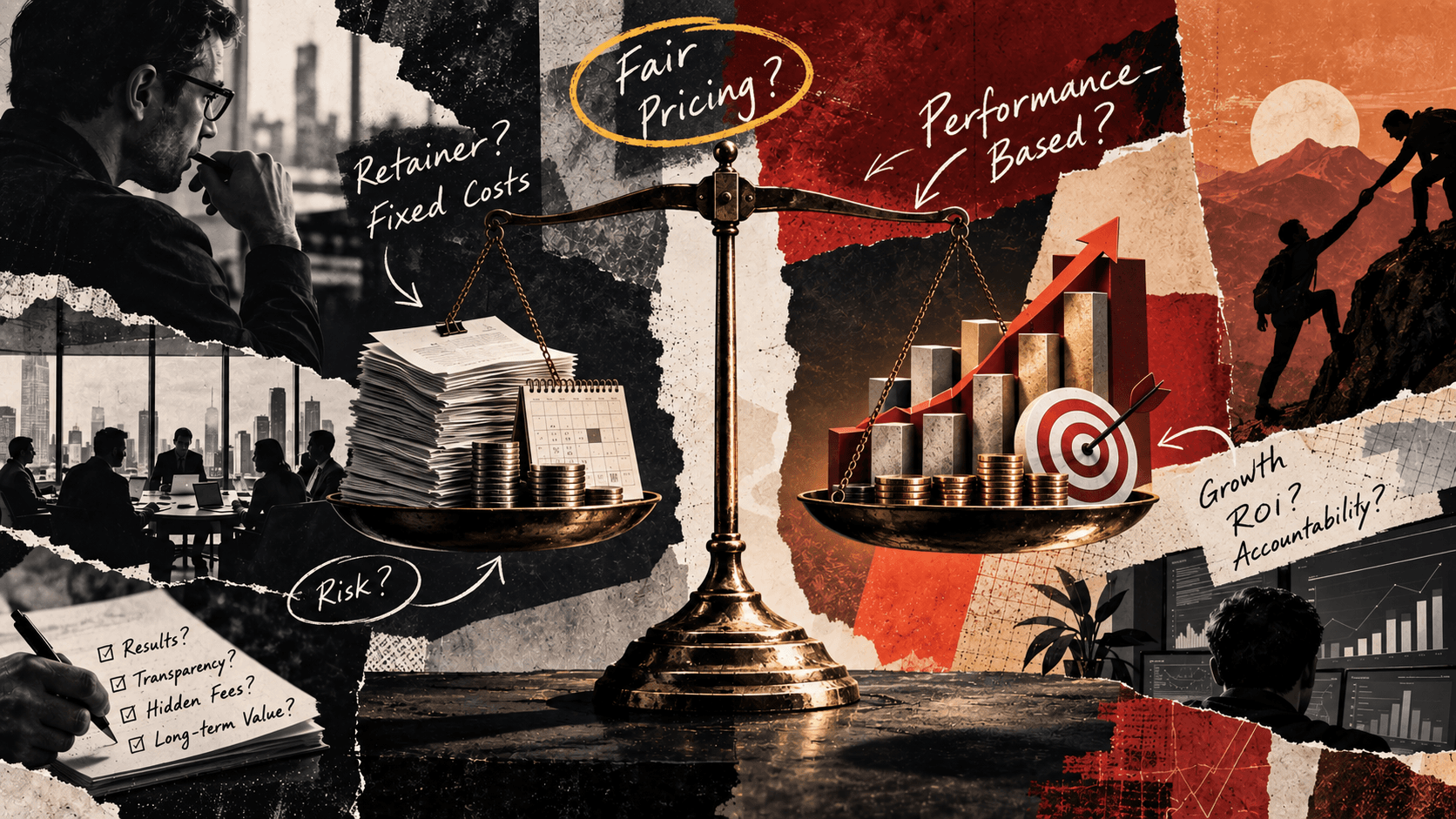
Retainer vs Performance-Based Pricing: What's Fairer?
Agency retainers and performance-based pricing align incentives very differently. Here's what actually determines which model is fairer for a given engagement.
By Abhilash LR
A retainer pays an agency the same fee whether your campaigns win or lose. Performance-based pricing ties the fee to what the agency actually delivers. Neither model is inherently fairer — each is fair for a different kind of work. The mistake most founders make is picking a model because it's the industry default, not because it fits their situation.
Here's how to tell which one actually protects you.
Key Takeaways
Retainers are fair for slow or hard-to-attribute work — brand, SEO, early-stage testing.
Performance-based pricing is fair when the outcome is fast and cleanly measurable — paid media with a clear ROAS, CPA, or install target is the classic case, and it's genuinely harder to hide a bad month behind vague language once the fee itself is tied to a number.
Performance pricing has a real failure mode too: it can push an agency toward short-term tactics that hit the metric while quietly damaging the account.
One question exposes which model you're really on: what happens to the fee if results are flat for a quarter?
What Each Model Actually Is
Retainers are a fixed monthly fee for the agency's time and attention, independent of outcome. Billing is simple and budgeting is simple — you know the number every month, whatever happens, which is why the model became the industry default.
Performance-based pricing ties some or all of the fee to a defined outcome. That might be a percentage of ad spend that scales with results, a bonus tied to ROAS or CPA, or a flat rate per qualified lead or app install. The mechanics vary, but the principle is the same: the agency's income moves when your results move.
Conceptual line chart, not measured data. A retainer fee stays flat regardless of results delivered. A performance-based fee rises as results improve, aligning what the agency earns with what the client gets.Results delivered (ROAS, leads, installs) →Agency fee →RetainerPerformance-basedConceptual, not measured data — illustrates the incentive question, not a benchmark
When a Retainer Is Actually the Fairer Deal
Retainers earn their reputation unfairly. They're the right model whenever the work is real but the outcome is slow or hard to isolate. On SEO timelines, Google's own Search Central guidance says some changes take effect in hours, others in several months. Former Googler Maile Ohye put a sharper number on it: "four months to a year" before you see the benefit.
Neither timeline fits a fee tied to next month's number. Brand campaigns build awareness that shows up in sales months later, across channels no single fee model can cleanly credit. Paying an agency purely on an outcome that's this delayed or diffuse just pushes them toward whatever is fast to measure — which usually isn't the work you actually need.
A retainer is also the honest choice early on. Before you have enough data to define a fair performance target, setting a CPA bonus just invites a number picked to be easy, not accurate.
When Performance-Based Pricing Is the Fairer Deal
Flip the conditions and performance pricing wins. Paid media with a defined KPI — ROAS on ecommerce, cost per install on an app, cost per qualified lead on B2B — is fast, clean, and directly attributable. There's no good reason to pay a flat fee for work whose result you can see inside a month.
This is close to how performance marketing is supposed to work in the first place: judged by an accountable number, not by hours billed. It's also the model we've built our own pricing around. Coact is explicit about this on our own site. Instead of a flat monthly retainer, we tie a meaningful portion of our fee to the outcomes we deliver — ROAS, qualified leads, or app installs. Clients pay for measurable results, not for effort, and traditional agencies rarely offer that: most charge a retainer regardless of what they deliver.
In our experience pitching against them, the retainer default is especially entrenched in India, Singapore, and Indonesia — large network agencies and traditional media-buying shops here still routinely lock clients into flat 6–12 month retainers as standard practice. That's well after more mature markets started shifting toward hybrid and performance models. It's also what makes a genuine KPI-based alternative a real differentiator here, not a marginal one.
The Honest Comparison
RetainerPerformance-BasedHybridYou pay forTime and attentionDefined outcomesA lower base + upside on resultsFair whenSlow or hard-to-attribute outcomesFast, clean, measurable outcomesMost real accounts, in practiceAgency's riskNone — paid regardlessReal — no results, less feeSharedYour riskPay even if nothing worksAgency may chase the metric, not the businessLower, but requires a well-defined KPIWatch forNo accountability clauseVanity-metric gamingWhether the split actually shifts risk
Most real engagements land in the hybrid row: a smaller base retainer that covers strategy and reporting, plus a bonus or percentage tied to a genuine, hard-to-game KPI. The lower base makes the relationship survivable during a slow month; the upside keeps the incentive honest.
The Failure Mode Nobody Advertises
Performance pricing sounds obviously fairer, so most articles stop at "pay for results." That's incomplete. Tying a fee tightly to one metric creates pressure to win that metric specifically — sometimes at the account's expense. An agency paid purely on install volume can hit the number with low-quality users who churn immediately. One paid purely on lead count can flood the funnel with unqualified leads a sales team then has to filter out by hand.
The fix isn't abandoning performance pricing — it's picking the right metric. Tie the fee to an outcome that's genuinely hard to fake. ROAS calculated against your real margins is much harder to game than raw click volume, and cheap, low-value traffic can't inflate it the way it inflates a lead or install count.
What to Actually Ask an Agency
One question exposes which model you're really being offered, whatever it's called on the invoice: what happens to their fee if results are flat for a quarter?
If the answer is "nothing changes," you're on a retainer — which may be exactly right for the work, but you should know it going in. If the fee genuinely drops when results don't show up, you're on real performance pricing. Anything in between is a hybrid, and the honest next question is how much of the fee actually moves.
Not sure which model fits your situation? Book a free discovery call — we'll tell you honestly, even where a straight retainer is the right call for you.
Frequently Asked Questions
Is performance-based pricing always cheaper than a retainer?
Not necessarily — it's structured differently, not automatically cheaper. A high-performing account can cost more under performance pricing than a flat retainer would have, simply because the agency is now being paid for real results instead of time. What you pay tracks what you got.
What's a fair percentage for performance-based agency fees?
There's no single fair number. It depends on margin, spend level, and the specific KPI. What matters more than the exact percentage is whether the metric is genuinely hard to game — margin-adjusted ROAS is a fairer basis for a fee than raw lead count, even at the identical percentage.
Can an agency really work on pure performance pricing?
Some can, for a defined, fast-feedback channel like ecommerce paid media with clean attribution — but very few take on pure performance pricing across an entire account, because slower or harder-to-attribute work like SEO, brand, or early testing just doesn't fit the model. In practice, a hybrid of base plus upside is far more common than pure performance pay.
What questions should I ask about an agency's pricing model?
Ask what happens to their fee if results are flat for a quarter. The answer alone reveals whether you're really on a retainer, real performance pricing, or a hybrid. Then ask which metric any performance component is tied to, and whether it can be gamed with low-quality volume.
Why do most agencies default to retainers instead of performance pricing?
Simplicity, mostly. Retainers are easier to bill, easier to plan around, and carry no downside risk for the agency. Performance pricing demands the agency accept real risk, plus a metric that's fast, clean, and hard to fake — conditions that don't hold for every kind of marketing work. That gap is exactly why retainers remain the default even where they aren't the fairer fit.
Conclusion
Neither pricing model is a scam, and neither is automatically fair — one protects the agency from work that's genuinely hard to attribute quickly, the other protects you whenever the outcome is fast and clean enough to measure honestly.
So ask what happens to the fee in a flat quarter, before you sign anything. Pick the metric carefully if you go performance-based. Don't assume the industry default is the right fit for your specific work just because it's what everyone else does.
How this post was compiled. The retainer and performance-based mechanics described are standard industry practice, not claims requiring external citation. The SEO-timeline range is Google's own Search Central guidance, verified directly; the specific "four months to a year" figure is a direct quote from former Google engineer Maile Ohye, relayed by Search Engine Land and not independently re-verifiable at the primary source. Coact's own pricing model is quoted directly from our site's published FAQ and positioning copy — this is our actual stated model, not a hypothetical example. Written by Abhilash LR, founder of Coact, a performance marketing agency working across Singapore, India, and Indonesia.
Continue Learning
In-House vs Agency vs Fractional: Resourcing Growth in 2026 — the resourcing decision this pricing question sits inside
Performance Marketing in 2026: The Complete Guide — the discipline this pricing model is meant to serve
What's a Good ROAS by Industry? — set the KPI a performance fee should actually track
Get your free Growth Audit — no pitch, 30 minutes
Want results like these for your brand?
COACT runs performance-based growth across SEA & India. Start with a free 15-day pilot.
Book a discovery callKeep reading
12 Questions to Ask Before Hiring a Growth Agency
The average client-agency relationship now lasts about 7 years. These are the 12 questions that separate a good long-term fit from a costly mismatch.
In-House vs Agency vs Fractional: Resourcing Growth in 2026
Should you hire in-house, retain an agency, or bring on fractional help? The real cost, speed, and control trade-offs behind each path — with sourced salary and rate data.