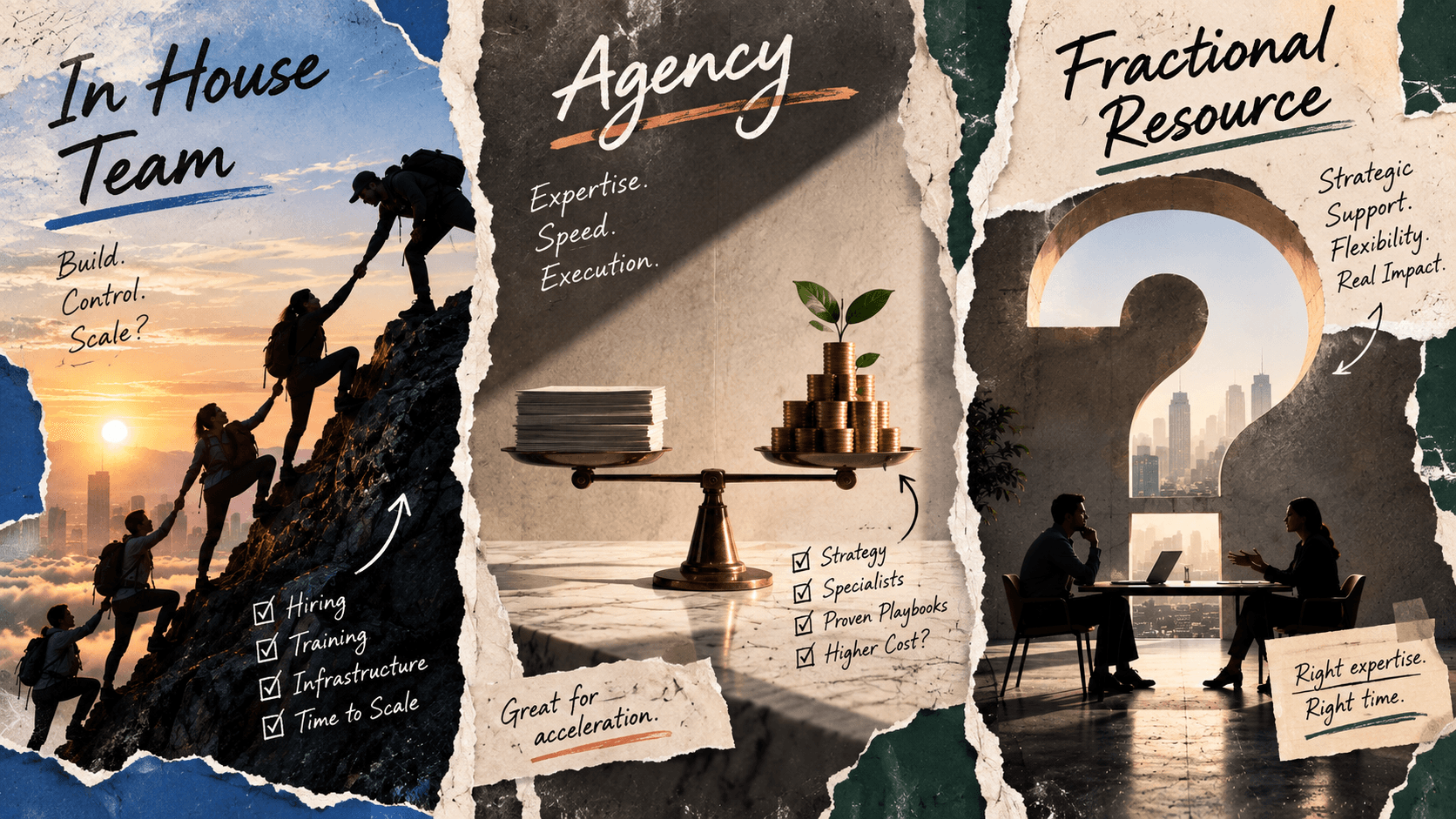
In-House vs Agency vs Fractional: Resourcing Growth in 2026
Should you hire in-house, retain an agency, or bring on fractional help? The real cost, speed, and control trade-offs behind each path — with sourced salary and rate data.
By Abhilash LR
There are exactly three ways to resource growth: hire someone full-time, retain an agency, or bring in a fractional leader part-time. Most founders pick based on gut feel or whoever pitched them last. Each option solves a different problem, at a different cost. The wrong match is the single most common reason growth spend underperforms — not the channel, not the creative, but the resourcing decision made months before any of that.
This is the framework: what each option actually costs, what each is genuinely good at, and how to decide — with real salary and market-rate data, not vibes.
Key Takeaways
In-house buys full-time focus, but a senior growth hire in India or Singapore runs into six figures loaded.
Agency retainers buy a team and channel expertise on demand — typically priced as a flat fee or a percentage of ad spend — but strategic ownership stays thin unless you demand it.
Fractional leadership buys senior strategic judgement part-time, typically cheaper than a full-time executive hire, but it doesn't execute campaigns day-to-day.
Several widely-repeated "fractional CMO ROI" statistics — a specific HBR revenue-growth figure, a Gartner adoption forecast, a "120,000 leaders" count — could not be traced to an actual named study anywhere we looked, so we're not repeating them here.
What Each Option Actually Costs
Start with the real numbers, because most of the content on this topic skips straight to advice without them.
In-house. In India, a senior Growth/Digital Marketing Manager averages ₹16.75 lakh a year on Glassdoor. AmbitionBox's crowdsourced data puts a Growth Manager at ₹12 lakh average (₹4–30 lakh range), rising to ₹13–15 lakh in Bengaluru/Mumbai/Delhi NCR and ₹20–25 lakh at top internet companies. In Singapore, Morgan McKinley's 2026 salary guide puts a Digital Marketing Manager at S$120,000 (5–10 years' experience), S$150,000 (10–15 years), and S$180,000 (15+ years) per annum.
Add recruiting cost, benefits, tooling, and ramp time, and a single senior in-house hire is a meaningful six-figure commitment before they've run one campaign. If that one person is wrong for the role, you've bought their specific skill gaps too.
Horizontal range bars. A fully-loaded senior in-house growth hire runs roughly 60 to 140 thousand dollars a year depending on market. A mid-tier agency retainer runs roughly 24 to 72 thousand a year. A fractional growth leader at a growth-stage rate of 8 to 12 thousand a month runs roughly 96 to 144 thousand a year. These are illustrative bands from named salary and marketplace sources, not a single authoritative benchmark.$60K$140KIn-house (1 senior hire)$24K$72KAgency (mid-tier retainer)$96K$144KFractional (growth-stage)Illustrative annual cost, US$ equivalent (varies by market and scope)Ranges from named salary guides and fractional-CMO marketplaces — not a single benchmark.
Agency. Retainers are usually structured as a flat monthly fee, a percentage of ad spend, or a hybrid. Clutch's marketplace data is drawn from a large sample of digital marketing companies. It puts typical agency hourly rates around $25–49/hour for general digital marketing work, rising to $100–149/hour for specialised services like paid search and SEO. Most reviewed projects land in the $10,000–50,000 range.
Percentage-of-spend models commonly run 10–20% of monthly ad spend, decreasing as budgets scale. The incentive is useful — the agency earns more as your results grow — but it only makes economic sense once you're spending enough (roughly $10K+/month) to justify dedicated attention.
Fractional. This means a senior growth leader working with you part-time rather than full-time. Fractional-CMO marketplaces converge on roughly $5,000–15,000 a month for most engagements, with a common $8,000–12,000/month "sweet spot" for growth-stage companies, up to $20,000+/month for enterprise-scale work. Set against the loaded cost of a full-time senior executive, that's real savings — but you're buying strategic hours, not execution hours.
The Honest Comparison
In-houseAgencyFractionalWhat you getFull-time focus, one skill setA team, channel expertise, toolingSenior strategic judgement, part-timeTypical cost~₹12–25L/yr (India), ~S$120–180K/yr (SG), loadedRetainer or 10–20% of ad spend~$5–15K/month (growth-stage: $8–12K)Best forOne core channel, long runway to build in-house muscleExecution capacity across multiple channelsStrategy, oversight, and vendor management without a full seatWeak pointSingle point of failure; hiring riskStrategic ownership can stay thinDoesn't run campaigns day-to-dayRamp timeWeeks to months (hire + onboard)Days to weeksDays
Most companies that get this right don't pick one lane forever. They combine models as they scale — a fractional lead setting strategy, for example, while holding an agency or in-house team accountable for execution.
Not sure which lane fits your situation? Book a free discovery call and we'll give you an honest read — even if the honest answer isn't us.
When In-House Wins
Three conditions make in-house the right call. Growth depends on deep, ongoing product or customer knowledge that's expensive to keep re-explaining to an outside partner. You have the runway to absorb a multi-month ramp. And the growth function is becoming a core, permanent part of the business, not a project.
The risk you're accepting is concentration: one person's skill ceiling becomes your channel's skill ceiling, and losing them means losing the institutional knowledge too.
When an Agency Wins
Agencies win when you need execution capacity across several channels at once. Running and testing paid social, search, and creative simultaneously is genuinely hard for one in-house hire to do well. It's part of why how much a startup should spend on Meta ads is rarely a single-channel question. Beyond raw capacity, a good agency brings pattern-matching from other accounts, plus platform relationships and tooling you'd otherwise have to build from scratch.
The risk is that a retainer can look like ownership without actually being ownership. Ask any agency you're evaluating exactly who is accountable for what, and how you'd know if they weren't delivering. Our companion post, 12 Questions to Ask Before Hiring a Growth Agency, goes deeper on exactly this (our Red Flags: How to Spot a Bad Performance Marketing Agency post, publishing soon, will cover the warning signs specifically).
When Fractional Wins
Fractional leadership is the right call when you need senior judgement — someone who's built and scaled growth before — without the cost or full-time commitment of an executive hire. It often works best alongside an agency or a smaller in-house team rather than instead of one: the fractional leader sets strategy and holds whoever executes accountable. It's a poor fit if what you actually need is more hands running campaigns, since a fractional leader's time is bounded by design.
What We Won't Repeat
The same set of statistics shows up on nearly every "fractional CMO" article online. One is a precise Harvard Business Review figure claiming companies using fractional CMOs grow revenue at 29% versus 19% for those that don't. Another is a Gartner forecast that 30%+ of midsize enterprises will have a fractional executive by 2027. A third puts the global count at "120,000 fractional leaders."
We looked for the original studies behind each one. None of them traces to a findable, citable HBR article or Gartner report. Every instance we found was one marketing blog citing another, with the trail going cold before an actual publication.
That's the exact pattern behind several stats we've rejected in past posts on this blog, and we're applying the same standard here: if we can't find the primary source, we don't repeat the number. The real, checkable data — the fractional-CMO market-rate convergence above — is enough to make the case honestly.
Frequently Asked Questions
Is it cheaper to hire in-house or use an agency?
It depends on spend level and scope. A senior in-house growth hire in India runs roughly ₹12–25 lakh a year loaded (Glassdoor / AmbitionBox), and in Singapore roughly S$120–180K depending on seniority (Morgan McKinley). An agency retainer or percentage-of-spend fee (commonly 10–20% of ad spend) can be cheaper at lower budgets and more expensive at very high ones. But it also buys a team and multi-channel expertise a single hire can't replicate alone.
What does a fractional CMO actually cost?
Fractional-CMO marketplaces converge on roughly $5,000–15,000 a month for most engagements, with an $8,000–12,000/month sweet spot common for growth-stage companies, and $20,000+/month for enterprise-scale work. That compares to a fully-loaded full-time senior marketing executive, which typically costs several times more annually once salary, benefits, and hiring risk are counted.
Should a startup hire an agency or build an in-house team first?
There's no universal answer, but a useful heuristic is capacity versus ownership: if you need execution across multiple channels immediately and don't yet have the runway to hire and ramp a specialist, an agency gets you moving faster. If one channel is becoming core to the business and you have the runway to build institutional knowledge, an in-house hire pays off over a longer horizon. Many companies use both at different stages, or an agency plus a fractional lead for oversight.
Is the "fractional CMOs grow revenue 29% vs 19%" statistic real?
We could not verify it. It's widely repeated online and consistently attributed to Harvard Business Review, but no source we found linked to an actual HBR article, and the number appears to originate from marketing blogs citing one another rather than a traceable study. Treat it, and similar unsourced "fractional executive" statistics circulating online, with real skepticism.
Can I combine in-house, agency, and fractional models?
Yes, and many growth-stage companies do — for example, a fractional leader setting strategy and holding an in-house specialist or an agency accountable for execution, rather than paying for a full executive seat. The three models aren't mutually exclusive; they solve for focus, capacity, and judgement respectively, and combining them is often more cost-effective than trying to get all three from one full-time hire.
Conclusion
The resourcing decision is not about which model is "best" — it's about which problem you actually have. In-house buys focus, agencies buy capacity, fractional buys judgement, and each has a real, checkable cost you can compare before you commit. Skip the vendor-blog statistics that don't trace to anything, do the real math for your market and stage, and don't be afraid to combine models as you grow.
How this post was compiled. Morgan McKinley's 2026 Singapore Salary Guide was fetched and verified directly. Glassdoor, AmbitionBox, and Clutch figures were confirmed via search-grounded retrieval rather than independently re-fetched pages, since all three platforms block direct automated access. The figures cited are what each platform itself reports, not a third-party paraphrase.
Fractional-CMO market-rate ranges reflect convergent figures across multiple independent fractional-executive marketplaces. We explicitly did not repeat several widely-circulated "fractional CMO ROI" statistics — a specific HBR revenue-growth figure, a Gartner 2027 adoption forecast, a "120,000 fractional leaders" count — after being unable to trace any of them to a findable primary source. See our editorial standards for how we handle sourcing generally. Written by Abhilash LR, founder of Coact, a performance marketing agency working across Singapore, India, and Indonesia.
Continue Learning
How Much Does a Performance Marketing Agency Cost in India? (publishing soon)
Retainer vs Performance-Based Pricing: What's Fairer? — the fee-model differentiator, explained in full
Building Predictable Growth Systems for Startups — what a growth function needs once you've resourced it: hiring sequence, budget cadence, and the systems that keep it repeatable rather than a series of one-off campaigns
Get your free Growth Audit — no pitch, 30 minutes
Want results like these for your brand?
COACT runs performance-based growth across SEA & India. Start with a free 15-day pilot.
Book a discovery callKeep reading
12 Questions to Ask Before Hiring a Growth Agency
The average client-agency relationship now lasts about 7 years. These are the 12 questions that separate a good long-term fit from a costly mismatch.
Retainer vs Performance-Based Pricing: What's Fairer?
Agency retainers and performance-based pricing align incentives very differently. Here's what actually determines which model is fairer for a given engagement.