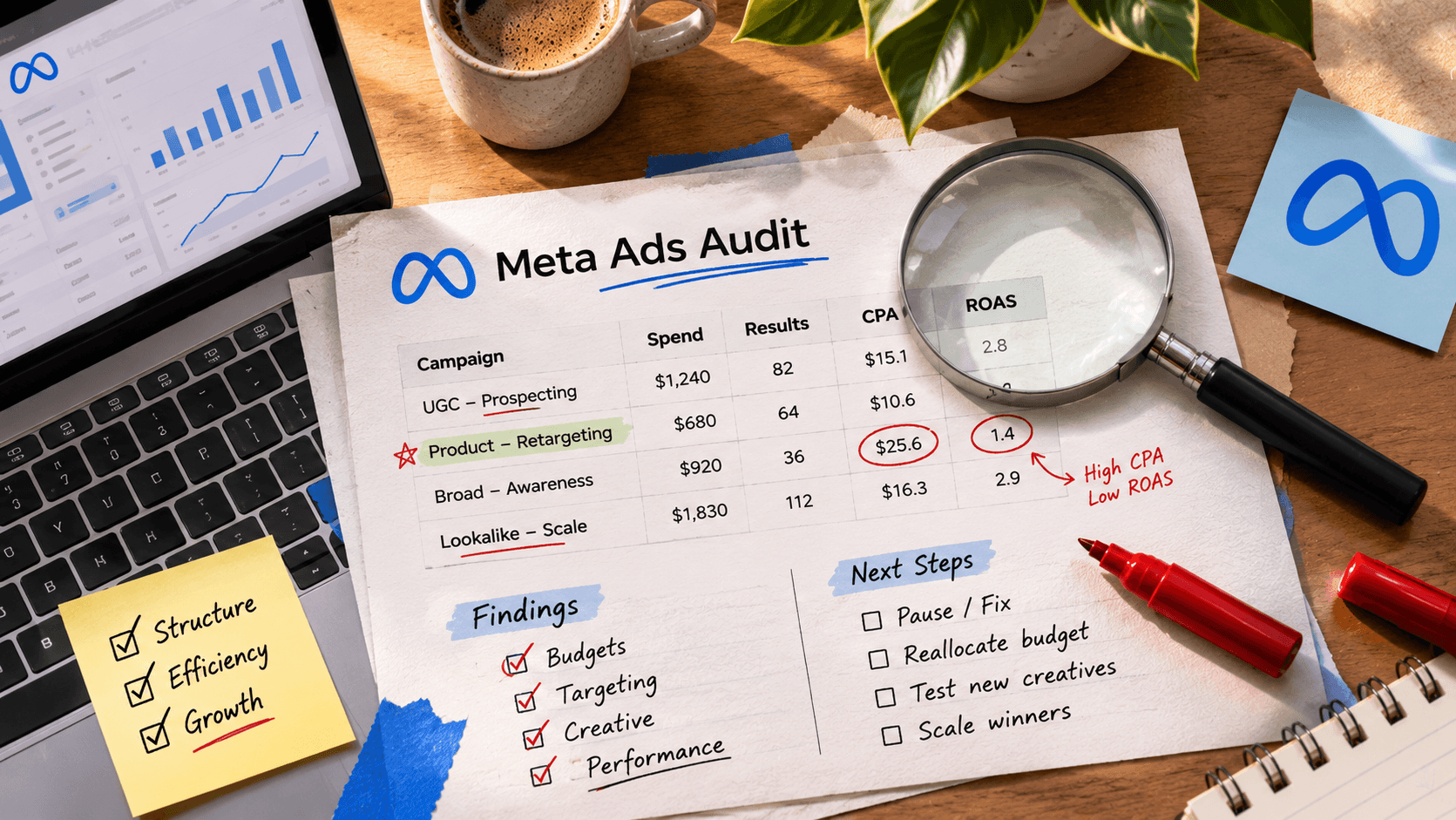
Meta Ads Audit Checklist 2026: Andromeda-Era Guide
Run a 7-part Meta Ads audit built for Andromeda, Meta's retrieval engine that reported a +6% recall gain on selected segments. Pass/fail checks for every step.
By Abhilash LR
A Meta Ads audit in 2026 should test two things: whether Meta receives clean conversion signals from your account, and whether your account gives Andromeda enough distinct creative to retrieve. Meta's engineering team reported a +6% recall improvement and a +8% ads quality improvement on selected segments when it announced Andromeda in December 2024.
That changes the order of operations. Before you touch bids or audiences, you check the inputs Meta's system learns from. This guide turns that idea into a numbered audit with pass and fail criteria for each step.
Abhilash has spent a decade working with startups and scaleups, and the same pattern keeps appearing: incomplete data loops undermine growth long before creative or bidding does. That is why this checklist starts with tracking, not ads.
Key Takeaways
- Andromeda is Meta's ad-retrieval engine, and Meta reported a +6% recall improvement and +8% ads quality improvement on selected segments.
- Audit the inputs first: conversion signals, then creative variety.
- Seven sections follow, each with pass/fail checks.
- Check Conversions API and Event Match Quality before anything else.
What Changed With Andromeda, and Why Does It Matter for an Audit?
Meta's engineering team described Andromeda as a new retrieval engine and reported a +6% recall improvement and a +8% ads quality improvement on selected segments, announced on December 2, 2024. For auditors, the takeaway is simple: retrieval picks from the ads and signals your account supplies.
Retrieval is the first stage of Meta's ad pipeline. It narrows tens of millions of possible ads down to a shortlist before ranking begins. Meta says Andromeda replaced the earlier layered retrieval stack with a single large neural model, running on NVIDIA Grace Hopper hardware.
Meta also reported a gain of more than 3x in inference throughput. That is what let the system keep pace with the growing volume of ad variations that Advantage+ and generative AI tools produce.
The audit implication: retrieval only works on ads that exist and are active. Take a hypothetical account running three static creatives that haven't changed in four months: Andromeda has almost nothing to retrieve beyond those three. No amount of budget or bidding sophistication fixes a candidate-pool problem.
How Do You Run a Meta Ads Audit?
Run the audit in the order below, because each section depends on the one before it. Meta's system optimises against the signals you send, so tracking comes first and reporting comes last. A creative problem is hard to diagnose if the conversion data behind it is wrong.
For each section, mark every item pass, fail, or unknown. Treat "unknown" as a fail until you can confirm it. Keep a simple sheet with one row per item and a column for the fix, owner, and date.
Open Ads Manager and Events Manager in separate tabs before you start. If you are new to the interface, our guide on how to read Ads Manager covers the columns and breakdowns used below.
1. Tracking and Conversions API: Is Meta Getting Clean Signals?
Start here because every later check inherits whatever is wrong with measurement. Event Match Quality (EMQ) is Meta's diagnostic, scored 0 to 10 per event in Events Manager, showing how confidently Meta can match a conversion you sent back to a known person. Low scores weaken optimisation built on top.
What to check in Events Manager
Work through these items and mark each one.
- Is Conversions API sending server-side events, not just browser Pixel fires?
- EMQ for each key event (purchase, lead, add-to-cart), not one account-wide impression.
- Which customer parameters are passed with each event, such as hashed email, phone number, and external ID?
- Are browser and server events deduplicated, so one purchase isn't counted twice?
- Check whether EMQ was re-tested after your last consent-banner, checkout, or site change.
Where this goes wrong: a well-intentioned consent update or checkout redesign can silently drop match rate, and nobody notices for weeks. Re-check EMQ after every tracking change.
For setup steps, see our walkthrough on how to set up conversion tracking.
What good and bad look like
| Check | Pass | Fail |
|---|---|---|
| Conversions API | Connected and sending server events | Switched on but sending nothing, or absent |
| EMQ by event | Key events score consistently | One event sits far below the others |
| Customer parameters | Several identifiers passed where legally allowed | Only one parameter, or none |
| Deduplication | Browser and server events paired | Conversions appear counted twice |
Adding a hashed phone number next to email, where you legally and contractually can, is often a useful fix for a weak event.
Why does browser-only tracking deserve extra attention in India, Singapore, and Indonesia?
Browser-only tracking can be more fragile where much of your audience arrives from inside WhatsApp, Instagram, or another in-app browser. Third-party cookie loss and in-app browsers can suppress some pixel fires. Conversions API sends the same event server-side, independent of what the browser allows through.
A practical test: compare conversions in Ads Manager with orders or leads in your own system for the same week. A large unexplained gap is a fail until you trace it.
2. Conversion and Attribution Settings: Are You Measuring the Right Thing?
Attribution settings decide which conversions Meta credits to your ads, so a wrong setting changes every result you read. The audit question is whether your optimisation event and attribution window match how customers actually buy. A mismatch produces numbers that look precise and mislead you.
Check these items:
- Does each campaign optimise for the event that represents real business value, not an easier event further up the funnel?
- Check whether the attribution setting is the same across campaigns you plan to compare.
- The attribution window behind the headline ROAS column, and whether your team knows it.
- Check whether the optimisation event has enough volume to leave learning, as covered in section 3.
A campaign optimising for add-to-cart will find people who add to cart. If your goal is purchases or qualified leads, that campaign is a fail even when its cost per result looks low.
Attribution is a modelling choice, not a fact. Our explainers on attribution measurement and attribution models show how different models credit the same sale differently.
3. Account Structure and Learning-Phase Health
A healthy account structure gives each ad set enough data to learn and avoids splitting budget so thinly that nothing exits the learning phase. Fragmentation and constant edits are the two structural faults to look for. Both are visible in Ads Manager in a few minutes.
Check these items:
- Count of ad sets in Learning Limited.
- Number of edits per campaign (budget, audience, creative) in the last two weeks. Significant edits before learning completes can restart it.
- Do several ad sets target near-identical audiences and compete in the same auction?
- Does campaign count match your business logic, not a historical habit of duplicating campaigns for every idea?
A pile of small ad sets, each too thin to learn, is a different problem from one large ad set that can't be tested. Count both.
Our piece on why scaling budget breaks ROAS explains how structure and spend interact.
4. Creative Diversity and Fatigue: Does Andromeda Have Enough to Retrieve?
Because retrieval depends on having distinct creative candidates, the creative audit shifts from "does this ad look good" to "does this account have enough genuinely different ads." Count what is active, then judge how different those ads really are, then check for decay.
Check these items:
- Active creative count against spend level. A low-spend account and a high-spend account with two ads each have different problems, but both under-supply retrieval.
- Check whether variation is real. Five ads with one layout and different headlines give Andromeda far less to differentiate than five ads built around different hooks, formats, or angles.
- Check the format mix across static, video, and Reels-native creative, since placements behave differently.
- Check refresh cadence against performance decay, not the calendar.
Drop the old habit of replacing ads because they are old. A creative that still performs doesn't need replacing. One that is decaying does, however new it is.
How do you spot fatigue?
Look at frequency, click-through rate, and cost per result by ad over time. A rising frequency paired with falling click-through and rising cost is the classic pattern. Our guide to ad fatigue on Meta covers the signals in detail.
If creative is thin, a structured test plan helps more than random new uploads. See creative testing for a method.
5. Audiences and Advantage+: Are You Giving Automation Enough to Work With?
Advantage+ campaigns can only use the creative and signal you supply. The audit question is not whether to use automation but whether your setup gives it a fair chance. Set-and-forget configurations and heavily restricted audiences are the two patterns to test for.
Check these items:
- Do Advantage+ Shopping or App campaigns have enough creative variety and clean conversion data, or were they set up once and left alone?
- Are audience restrictions narrow enough to starve delivery without a clear business reason?
- Check whether custom audience sources (customer lists, site visitors) are recent and large enough to be useful.
- Existing-customer and new-customer traffic, separated or mixed in your reporting.
- Exclusions you added years ago, and whether they still make sense.
Custom audience quality depends on the same match quality discussed in section 1. A weak EMQ weakens the audiences built from it.
6. Budget and Bidding: Is Spend Going Where Results Actually Come From?
Budget and bidding should follow where results appear, which may differ from where spend has historically gone. Retrieval-stage changes can shift which placements and formats perform best, so an allocation that made sense before may no longer fit. Audit allocation against current results, not past habit.
Check these items:
- Does the largest budget share sit on the campaigns and formats with the best recent performance?
- Were budgets raised in small steps or in jumps that restarted learning?
- Check whether bid strategy and any cost or ROAS targets are realistic against recent actual results.
- Placement and format breakdowns, for pockets of waste or hidden strength.
A target set far tighter than recent results can throttle delivery, and a target far looser can allow expensive conversions. Compare the target with the last few weeks of actuals before you change it.
For scaling mechanics, read why scaling budget breaks ROAS.
7. Reporting Sanity Checks: Do the Numbers Hold Up?
Reporting checks confirm that what you read in Ads Manager matches what your business sees. Skip this step and every earlier conclusion rests on trust. The goal is to reconcile Meta's numbers against an independent source, then explain any gap rather than ignore it.
Check these items:
- Do Meta's conversions reconcile with orders, leads, or revenue in your own system for the same period?
- Do your dashboard and Ads Manager use the same date range, attribution setting, and conversion definition?
- Check whether reported ROAS is being compared across campaigns that use different attribution settings.
- Any single report that is the only evidence behind a major budget decision.
Meta's attributed figures and your CRM will rarely match exactly. The test is whether the gap is stable and explainable, not whether it is zero.
Pass means a documented reconciliation and a known, stable gap. Fail means no independent check, or a gap nobody can explain. If a spend decision keeps getting made from a single screen, that is a fail by itself.
If you also run Google Ads, the same reconciliation logic applies there. Our list of PPC audit red flags and guidance on how often to audit Google Ads cover the cross-platform side.
Audit Scorecard
Use this table to summarise your findings before you decide what to fix first.
| Section | What you're checking | Common red flag |
|---|---|---|
| 1. Tracking | CAPI status, EMQ per event, deduplication | Pixel-only tracking, uneven EMQ |
| 2. Attribution | Optimisation event, attribution setting | Optimising for a shallow event |
| 3. Structure | Learning status, edits, overlap | Frequent edits resetting learning |
| 4. Creative | Count, variation, format mix, decay | Recolor-only variety, stale ads |
| 5. Audiences | Advantage+ inputs, restrictions | Set-and-forget campaigns |
| 6. Budget | Allocation, pacing, targets | Budget on legacy campaigns |
| 7. Reporting | Reconciliation with your own data | Unexplained gap with the CRM |
Fix in order. A tracking fault usually matters more than a creative tweak, because it distorts everything you measure afterwards. If you decide to hand the audit to someone else, our list of questions to ask before hiring an ad auditor is a useful filter. If you would rather keep it in-house, see how to run Meta Ads yourself.
Frequently Asked Questions
Do I need to change my whole strategy because of Andromeda?
No. Change your inputs, not your strategy. Meta reported a +6% recall improvement and a +8% ads quality improvement on selected segments, but Andromeda didn't change what makes a good offer. The audit shift is giving the system enough creative variety and clean measurement data to work with.
What's a healthy Event Match Quality score?
Meta scores EMQ from 0 to 10 per event in Events Manager. Rather than chasing one universal target, compare your key events (purchase, lead) against each other. Fix the lowest-scoring event first, because that gap is often a missing parameter such as phone number or external ID, or a CAPI connection that isn't firing.
How many active ads should a Meta account be running?
Meta publishes no official number. The practical test is variety relative to spend. A high-spend account leaning on two or three near-identical creatives is under-supplying Andromeda's retrieval stage, whatever any generic benchmark says. Count genuinely different hooks, formats, and angles, not file count.
Is Conversions API mandatory now?
Not contractually, but it is close to essential for serious measurement where mobile and in-app browser traffic is heavy. Browser-only Pixel tracking keeps working. It can still suppress some pixel fires, so it may under-represent real conversions. Audit whether CAPI is sending events, not merely switched on.
Should I audit Meta and Google Ads on the same schedule?
Audit the measurement layer together and the platform mechanics separately. Andromeda's retrieval logic and Google's bidding logic are unrelated systems, so each needs its own checks. But clean data and a CRM reconciliation help both platforms, because weak measurement undermines each in the same way.
What if I don't have time to run this myself?
You can hand it to a specialist. Loupe by COACT runs a one-time Meta + Google Ads audit with a 133-point review, a recorded walkthrough, and prioritised fixes, with no retainer. Pricing is fixed at US$199, US$299 or US$399.
Get Your Account Audited
If you would rather have this checklist run for you, Loupe by COACT is a one-time Meta + Google Ads audit. It is a 133-point review of your account, delivered with a recorded walkthrough and prioritised fixes, so you know what to change first. There is no retainer, and pricing is fixed at US$199, US$299 or US$399. Start with Loupe by COACT, or contact COACT if you have questions before you decide.
Abhilash LR is the founder of COACT, a growth-focused agency operating across India, Southeast Asia and Singapore. He has spent a decade working with startups and scaleups, where he kept seeing the same problems: businesses leaving growth on the table because of the wrong partners, systems, strategy and incomplete data loops. COACT is built on the principles he works by: performance-driven, founder-obsessed, and focused on what actually moves the needle. COACT also sells Loupe, a fixed-price ad account audit. Questions or corrections: contact us. Learn more about COACT.
Published at www.coact.biz2026-09-30 · Abhilash LRWant results like these for your brand?
COACT runs performance-based growth across SEA & India. Start with a free 15-day pilot.
Book a strategy callKeep reading
Audit Findings: What to Do With Them, Step by Step
Turn audit findings into fixes in five steps, tracking first. Get an impact and effort table and learn how to judge a fix after Google's 7-day learning window.
Ad Account Audit: Do It In-House or Hire Someone?
Audit your ad account yourself or hire out? Use a 3-question test and a hybrid workflow, or a US$199 fixed-fee audit as a starting point if you need help.