Do You Need an llms.txt File? What the Evidence Says (2026)
Ahrefs checked 137,210 domains: 97% of llms.txt files got zero traffic. Google calls it 'purely speculative.' Here's the evidence — and what to do instead.
By Abhilash LR
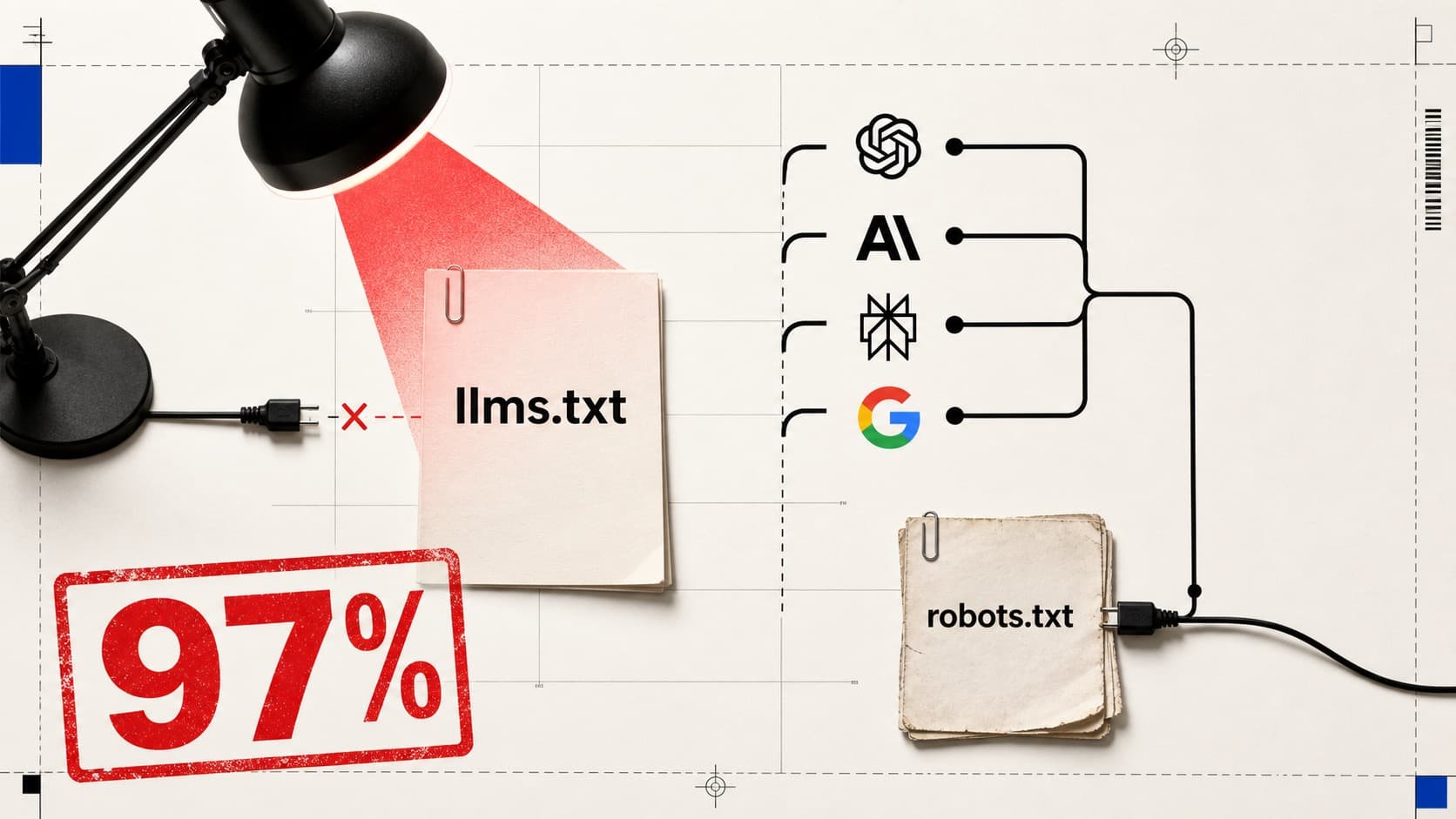
Short answer: almost certainly not. llms.txt is the file every AI-SEO checklist tells you to add — a Markdown summary of your site "for the LLMs." It's cheap, it feels responsible, and there's very little evidence anything reads it. When Ahrefs looked at 137,210 domains in May 2026, 97% of the llms.txt files received zero traffic for the entire month (Ahrefs). Not "low ROI." Not read.
This is the evidence-based version of the question, because it's one of the clearest cases where AEO advice has run ahead of reality — and a good chance to show what to do with the effort instead.
Key Takeaways
97% of llms.txt files got zero requests in a month across 137,210 domains (Ahrefs, May 2026). Of the few that were fetched, 96% of requests came from bots — mostly SEO tools, not AI engines.
No major AI provider — OpenAI, Anthropic, or Perplexity — has confirmed reading llms.txt at inference. Their published guidance is about crawler access and
robots.txt, not this file.Google's own view: it's "purely speculative for now… the file has existed for years, yet none of the AI systems use it."
It's cheap and harmless to add, but it drives nothing today. Spend the effort on citable content and crawler access, which demonstrably do.
What llms.txt Is Supposed to Do
The pitch is reasonable on its face. llms.txt is a proposed standard: a Markdown file at your domain root offering a clean, curated summary of your site and links to your most important pages. The idea is that an AI model, faced with your messy HTML, could read this instead and represent you more accurately. It's deliberately modelled on the familiar robots.txt and XML sitemap — which is exactly why it feels like an obvious best practice.
The problem isn't the idea. It's that adoption by the engines it's meant for never happened.
What the Evidence Actually Shows
Three independent signals all point the same way.
Nobody's fetching it. In Ahrefs' analysis of 137,210 domains, 97% of valid llms.txt files received no requests at all in May 2026. Of the small share that got any traffic, 96% of those requests came from bots — and the biggest sources were SEO audit tools, not AI platforms (Ahrefs). The file is mostly being read by the tools that told you to create it.
Proportion bar. Of 137,210 domains analysed by Ahrefs in May 2026, 97 percent of valid llms.txt files received zero requests during the month; only 3 percent received any request at all.97%received zero requests3% got any requestDo the AI engines actually read llms.txt? (137,210 domains, one month)And 96% of the few requests that arrived came from bots — mostly SEO tools, not AI.Source: Ahrefs, llms.txt study, May 2026. Retrieved 2026-08-01
The providers haven't adopted it. As of 2026, no major AI provider — OpenAI, Anthropic, or Perplexity — has confirmed that its assistant reads llms.txt when answering. Each publishes guidance for site owners, and all of it is about crawler user-agents and robots.txt access, not about this file — see, for example, OpenAI's bots documentation.
Google is openly skeptical. Google's Search Advocate John Mueller put it plainly: "I don't think anyone knows — it's purely speculative for now (the file has existed for years, yet none of the AI systems use it — what does it mean?)" (Search Engine Journal). Google's own guidance is that publishers don't need special AI files to appear in AI search experiences.
Three different vantage points — a large usage study, the providers' own docs, and Google — none of which support the checklist advice.
For what it's worth, we hold this view with our own eyes open: coact.biz serves an llms.txt too. It took a few minutes to add, it does no harm, and — going by the evidence above — we don't expect any AI engine to actually read it. We keep it because it's free and future-proofing is cheap, not because it does anything today. That's the honest posture on this file: add it if you like, expect nothing from it, and don't let it displace the work that matters.
Why the Idea Won't Die
If the evidence is this one-sided, why is llms.txt on every AEO checklist? Three reasons, none of them "it works":
It's intuitive. A tidy file that tells the robots about your site is a satisfying mental model, and it rhymes with
robots.txtand sitemaps that genuinely do matter.It's cheap and safe. Generating one takes minutes and breaks nothing, so it's easy to recommend and easy to adopt without ever checking whether it did anything.
It's a tidy answer to an anxious question. "How do I show up in AI?" is stressful and vague; "add this file" is concrete and calming. Concrete and calming beats correct in a checklist.
Adoption of the file is real — surveys put it around 10% of sites, higher among SEO-savvy ones. Adoption by the engines is what's missing, and that's the only adoption that matters.
What to Do With the Effort Instead
The good news: the things that actually get you into AI answers are known, evidence-backed, and where your time should go. Google states there are no special requirements to appear in AI Overviews — the same helpful, crawlable content that wins search wins AI answers.
Do this instead of llms.txtWhy it worksEvidencePublish specific, citable contentStatistics and quotations are the biggest levers for being citedAggarwal et al. (arXiv:2311.09735)Open robots.txt to AI crawlersBlocked crawlers make you invisible to AI answersOpenAI bot docsFix HTML structure and schemaThe same hygiene that wins Search wins AI answersGoogle Search Central
Concretely:
Publish specific, citable content. The one peer-reviewed study on generative-engine visibility found that adding statistics and quotations were the biggest levers. Real numbers and named sources are what an engine lifts and attributes. Our guide to optimising for AI search covers this in full.
Make sure the AI crawlers can reach you. This is the file that does matter —
robots.txt. If you've blocked GPTBot, OAI-SearchBot, or Google-Extended, you're invisible to the AI answer layer no matter what else you do. Check whether your brand is even showing up first.Get the fundamentals right — clean HTML, clear structure, standard schema. Not AI-specific magic; the same technical hygiene good SEO always wanted. We break down the disciplines in GEO vs SEO vs AEO.
The One Place llms.txt Might Earn Its Keep
To be fair to the idea: there's a narrow, honest use. AI coding tools that parse developer documentation can benefit from a curated Markdown index of your docs — it saves tokens and points the tool at the right pages. If you run a developer-facing product with extensive docs, an llms.txt for your documentation is a reasonable convenience for those tools. That's a specific engineering nicety, not a marketing tactic, and it's a long way from "add this file to rank in ChatGPT."
Frequently Asked Questions
Does llms.txt actually work?
There's very little evidence that it does. Ahrefs found that 97% of llms.txt files across 137,210 domains received zero traffic in May 2026, and of the small share that were fetched at all, 96% of requests came from bots — mostly SEO audit tools, not AI engines. On top of that, no major AI provider (OpenAI, Anthropic, or Perplexity) has confirmed reading it at inference, and Google's John Mueller calls it "purely speculative," noting the file has existed for years without any AI system using it. So the honest answer is: as of 2026 it does not measurably affect whether AI engines find or cite you. It's cheap and harmless to add — we run one on our own site — but treating it as a lever that changes your AI visibility is not supported by any data currently available.
Do ChatGPT, Claude, or Perplexity read llms.txt?
None of the three major providers has confirmed that it does. OpenAI, Anthropic, and Perplexity each publish official site-owner guidance for how their crawlers work, and in every case that guidance centres on crawler user-agents — GPTBot, ClaudeBot, PerplexityBot — and robots.txt access, not on llms.txt. None of their documentation mentions reading or prioritising an llms.txt file at inference time. Usage data backs this up from the other direction: Ahrefs' May 2026 study of 137,210 domains found that 97% of llms.txt files received zero requests in a month, and of the small share that were fetched, 96% of those requests came from SEO audit tools, not AI platforms. If ChatGPT, Claude, or Perplexity were reading llms.txt at any meaningful scale, that usage pattern would look very different. For now, the safest assumption is that none of them do.
Does Google use llms.txt for AI Overviews?
No — Google's own guidance says publishers don't need a special AI file to appear in AI Overviews or AI Mode. Google's Search Advocate John Mueller addressed llms.txt directly, describing it as "purely speculative for now," and noting that the file itself has existed for years without any AI system actually adopting it. Google hasn't published documentation instructing site owners to create one, which is notable given how detailed its guidance is for robots.txt, sitemaps, and structured data. Practically, this means AI Overviews and AI Mode draw on the same signals that already drive regular Search visibility: crawlable, well-structured, authoritative content indexed through the normal pipeline. There's no separate llms.txt-based track for AI answers — if your content already ranks and is well-structured for Search, it's already positioned for Google's AI surfaces.
Should I add an llms.txt file to my website?
You can — it takes minutes to write and won't break anything — but go in with the right expectations: the evidence says it won't move your AI visibility today. Ahrefs' study found 97% of these files get zero traffic, and no major AI provider has confirmed reading them, so treat it as optional housekeeping, not a priority. The one real exception is a developer-facing product with extensive documentation: a docs-focused llms.txt can genuinely help AI coding assistants navigate your reference material more efficiently, which is a legitimate engineering convenience rather than a marketing tactic. For most consumer and B2B sites, the hour you'd spend writing and maintaining an llms.txt file is better spent making your existing content more citable — clear statistics, direct quotations, unambiguous structure — and confirming AI crawlers like GPTBot and Google-Extended aren't accidentally blocked in robots.txt. Those two things have real, evidenced impact on whether AI engines find and cite you; llms.txt currently doesn't.
What should I do instead of llms.txt to appear in AI answers?
Three things, all with evidence behind them, unlike llms.txt. First, publish specific, sourced, citable content — the one peer-reviewed study on what makes content surface in AI-generated answers (Aggarwal et al., arXiv:2311.09735) found that statistics and direct quotations are the strongest levers, ahead of general authority or backlinks. Write content an AI model can lift a clean sentence or number from. Second, confirm AI crawlers aren't blocked: check that GPTBot, Google-Extended, ClaudeBot, and PerplexityBot are allowed in your robots.txt — a blocked crawler can't cite you no matter how good the content is, and this is a common, easy-to-miss mistake. Third, get the technical fundamentals right: clean HTML, a clear heading hierarchy, and standard schema markup (Article, FAQPage, Organization) so machines can parse your page's structure, not just its words. None of these is AI-specific magic — they're the same technical and editorial hygiene good SEO has always rewarded, because AI engines currently ride on the same crawlable web search engines already index.
Conclusion
llms.txt is a good example of how AI-search advice outruns AI-search reality. The idea is intuitive, the file is cheap, and the checklists love it — but the engines it's built for aren't reading it, the providers haven't adopted it, and Google calls it speculative. Add one if you like; it costs little. Just don't mistake it for a strategy. The effort that would have gone into a file nobody fetches is far better spent on citable content and open crawler access — the things the evidence actually supports.
How this post was compiled. The adoption figures (97% of llms.txt files received zero traffic; 96% of requests from bots) are from Ahrefs' May 2026 study of 137,210 domains, verified against the original write-up. Google's position is quoted from John Mueller via Search Engine Journal. The absence of confirmed provider support (OpenAI, Anthropic, Perplexity) reflects those companies' published site-owner guidance, which addresses crawler access rather than llms.txt. The "statistics and quotations" finding references the one peer-reviewed generative-visibility study (Aggarwal et al., arXiv:2311.09735). Written by Abhilash LR, founder of Coact, a performance marketing agency working across Singapore, India, and Indonesia.
Continue Learning
How to Optimise Your Site for AI Search in 2026 — what actually moves the needle
GEO vs SEO vs AEO: What's the Difference? — the disciplines, and which has real evidence
Is Your Brand Invisible to ChatGPT? — audit your AI visibility in 30 minutes
Talk to our team about an AI-search strategy based on evidence, not checklists.
Want results like these for your brand?
COACT runs performance-based growth across SEA & India. Start with a free 15-day pilot.
Book a discovery callKeep reading
How to Measure Marketing ROI (Without Fooling Yourself)
Marketing ROI is a one-line formula. The trap is the inputs: only 52% of marketers can prove their value, and reported ROI overstates what you actually caused.
AEO & GEO in 2026: A Guide for Southeast Asian Brands
The one peer-reviewed study of AI-search visibility found adding statistics lifts citations 37% — and keyword stuffing cuts them 9%. What works, sourced.