GEO vs SEO vs AEO: What's the Difference?
SEO ranks you in a list. AEO makes you the answer. GEO has the data: the one study found statistics lift AI-answer visibility +37% and keyword stuffing −9%.
By Abhilash LR
Three acronyms, one underlying question: when someone looks for what you sell, who gets the answer? SEO tries to rank your page in a list of links a person then clicks. AEO tries to make your content the answer an AI engine gives directly. GEO is the narrower, more rigorous cousin of AEO — and the only one of the three whose tactics have been measured in a peer-reviewed study.
That last distinction is the useful one, because most articles on this treat the three terms as interchangeable and then hand you tactics with no evidence behind any of them. Here's the real difference, what each is actually for, and — the part nobody answers honestly — which one deserves your budget in 2026.
Key Takeaways
- SEO optimizes to rank in the results list; AEO optimizes to be the answer an AI engine returns; GEO is the measured subset of AEO focused on visibility inside generated answers.
- GEO is the only one backed by a peer-reviewed study — which found adding statistics lifts visibility +37% and keyword stuffing cuts it −9% (arXiv:2311.09735).
- You don't choose one. SEO still drives most discovery; AEO/GEO decides whether you exist in the AI answer layer that's eating the clicks.
- The tactics that win at GEO would improve your SEO too. The reverse isn't true — some classic SEO habits actively hurt AI visibility.
The One-Line Definitions
Start with the cleanest version of each:
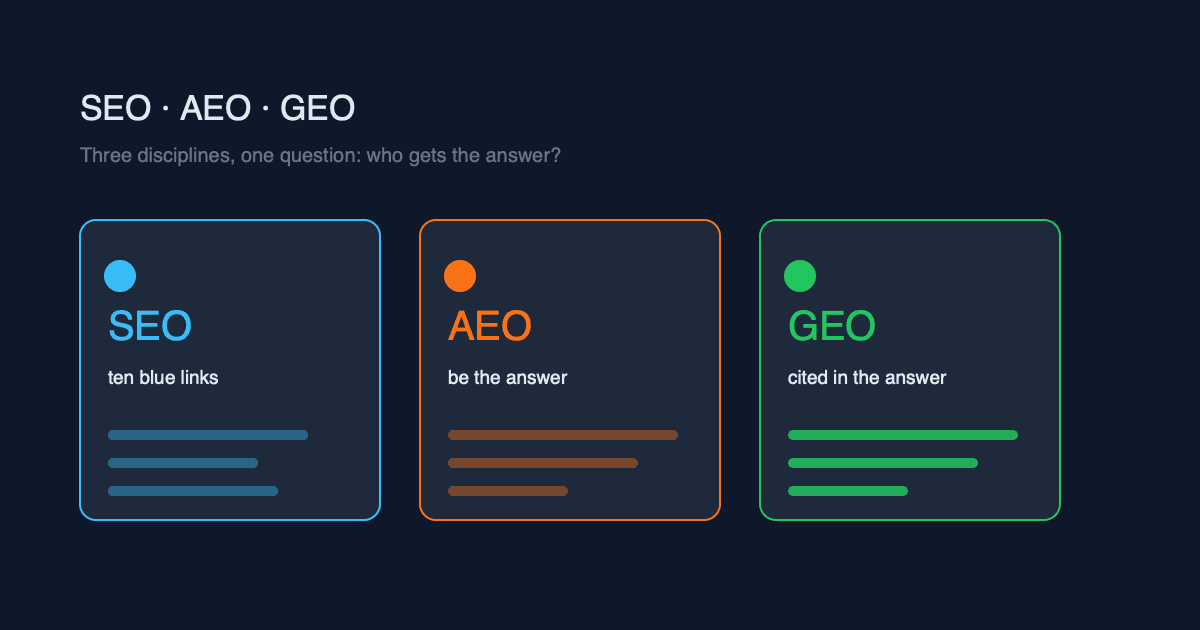
- SEO — Search Engine Optimization. Optimize so your page ranks high in the list of search results, and a human clicks through to your site. The win is a click. Decades of study behind it.
- AEO — Answer Engine Optimization. Optimize so your content is the answer an answer engine returns — a featured snippet, a voice-assistant reply, or now an AI chat response. The win is being cited, quoted, or summarised. An industry term, popularised by SEO practitioner Jason Barnard around 2017.
- GEO — Generative Engine Optimization. Optimize specifically for visibility inside the text a generative engine produces (ChatGPT, Perplexity, AI Overviews). The win is your source appearing in the generated answer. It comes from a 2023 academic paper (Aggarwal et al., presented at ACM KDD 2024) that actually measured which tactics work.
The relationship in one sentence: SEO is the older discipline, AEO is the broad goal of being the answer, and GEO is the part of that goal someone has run an experiment on.
Where the Three Actually Diverge
The definitions sound similar. The differences show up in what each optimizes for, what counts as success, and how much evidence stands behind it.
| SEO | AEO | GEO | |
|---|---|---|---|
| Optimizes for | Ranking in the results list | Being the answer any answer engine returns | Visibility inside generative-AI answers specifically |
| Win condition | A person clicks your link | You're cited, quoted, or summarised | Your source appears in the generated text |
| Primary surfaces | Google/Bing results pages | Snippets, voice, AI chat | ChatGPT, Perplexity, AI Overviews |
| Evidence base | Decades of study | Industry practice (term ~2017) | One peer-reviewed study (2023) |
| Classic tactic that helps | Keyword targeting, backlinks | Clear Q&A structure | Statistics, quotations, cited sources |
| Classic tactic that hurts | — | — | Keyword stuffing (−9%) |
Read the bottom two rows together, because that's the whole story. The behaviours that won the SEO game — keyword density, exact-match phrasing, repetition — are, in the one study that measured it, at best neutral and at worst counterproductive for generative visibility. AEO and GEO are not SEO with the keywords swapped. In one measurable respect, they're the opposite.
The Evidence Gap Between Them
Here's a distinction almost no comparison article makes: the three terms have wildly different amounts of evidence behind them, and you should weight your trust accordingly.
SEO has decades of studies, patents, and Google's own documentation. AEO is a useful framing with essentially no rigorous measurement — it's practitioner consensus about being the answer. GEO has exactly one thing SEO and AEO don't: a controlled experiment. Aggarwal et al. tested nine content strategies against a 10,000-query benchmark and measured how each changed a source's visibility in generative-engine responses. Here is the full result:
That chart is why GEO is the term worth taking literally. It's not a set of assertions — it's a ranking of measured effects. Adding quotations (+40%) and statistics (+37%) are the top levers; citing your sources (+28%) and writing fluently (+29%) follow; keyword stuffing (−9%) is the one thing that actively backfires. When we say GEO is "the part with data behind it," this is the data.
We should be precise about the limits, too: it's one study, on a benchmark rather than live production engines, from 2023. It is nonetheless the most rigorous public evidence in this whole field — which tells you how thin the evidence is everywhere else.
So Which One Do You Actually Invest In?
Wrong question, and the honest answer is more useful than a winner.
You don't pick one — the layers stack. SEO still drives the majority of discovery for most brands; being unfindable in traditional search is not a strategy. But the click that SEO earns is increasingly intercepted by an AI answer at the top of the page, which is what AEO and GEO are a response to. Ignoring the AI answer layer means conceding the searches where the user never scrolls to your beautifully-ranked link.
The good news is that the disciplines mostly reinforce each other. The GEO tactics — specific statistics, attributed quotes, named sources, plain language — make content more citable by AI and more useful to a human who clicks through from SEO. The one place they conflict is the SEO habit of keyword stuffing, which the data says to drop. So the practical sequence:
- Keep your SEO foundation. Findability is the precondition; an AI engine can't cite a page it can't crawl.
- Layer GEO's measured tactics on top. Statistics, quotes, sources, fluency — they cost nothing extra and help both audiences.
- Drop the one habit that backfires. Keyword stuffing hurt visibility in the only study that measured it.
That's it. There's no budget war between SEO and AEO — there's a foundation and a layer, and the layer is cheap if your content is already honest and specific. We apply the same "specific and sourced beats dense and repetitive" discipline to everything on this blog, including our breakdown of why CAC keeps climbing — and it's not a coincidence those posts get surfaced.
What This Looks Like in Southeast Asia and India
The regional angle is simple and underexploited: the AI answer layer already runs in your markets, and almost nobody local is optimizing for it.
Google's AI Overviews reached India in August 2024 and added Indonesian in October 2024, so the generative answer surface these disciplines target is live in Hindi, Bahasa Indonesia, and English across the region. Yet when you scan who ranks for "GEO vs SEO vs AEO" or "AI search optimization," the results are uniformly US- and globally-framed — no regional context, no local-language angle. The engines serve AI answers in your markets; the optimization content written for your markets barely exists. For a SEA brand, being early to GEO isn't a marginal edge — it's an uncontested one.
Frequently Asked Questions
What is the difference between SEO, AEO, and GEO?
SEO optimizes your page to rank in the list of search results so a person clicks it. AEO optimizes your content to be the answer an answer engine returns — cited, quoted, or summarised. GEO is the narrower, measured subset of AEO focused specifically on visibility inside generative-AI answers, and it's the only one of the three backed by a peer-reviewed study.
Is GEO just a rebrand of SEO?
No. They overlap — both reward useful, findable content — but they diverge on one measured point: keyword stuffing, a classic SEO tactic, reduced visibility inside AI answers by 9% in the only study that tested it, while adding statistics and quotations raised it. GEO rewards specific, sourced, citable content rather than keyword density.
Which is more important, SEO or AEO?
Neither replaces the other. SEO still drives most discovery, but the click it earns is increasingly intercepted by an AI answer on the results page — which is what AEO addresses. Treat SEO as the foundation (an engine can't cite a page it can't find) and AEO/GEO as a layer on top that decides whether you appear in the answer.
Where does the term GEO come from?
GEO (Generative Engine Optimization) comes from a 2023 academic paper by Aggarwal et al. from Princeton, Georgia Tech and collaborators, presented at ACM KDD 2024. It defined the problem and measured which content tactics improve a source's visibility inside AI-generated answers, using a 10,000-query benchmark. That measurement is what separates GEO from the looser, assertion-based AEO advice.
Do the same tactics work for all three?
Mostly they reinforce each other — specific statistics, attributed quotes, named sources, and plain language help AI visibility and human readers alike. The exception is keyword stuffing: useful-looking for old-school SEO, but measurably counterproductive for generative visibility. So the winning move is to keep your SEO foundation, add GEO's citable-content tactics, and drop the density habit.
Does any of this apply in India and Southeast Asia?
Yes. Google's AI Overviews launched in India in August 2024 and added Indonesian in October 2024, so the generative answer layer these disciplines target is already live in the region and its languages. Optimization content written specifically for SEA/India is scarce, which makes being early to GEO an unusually uncontested advantage locally.
Conclusion
The cleanest way to hold these three: SEO gets you into the list, AEO gets you into the answer, and GEO is the version of that with an experiment behind it. They're layers, not rivals — and the tactics that win the newest layer, statistics and quotes and sources, happen to be the ones that make content genuinely better. The only real behaviour change the evidence demands is dropping keyword stuffing, which was never doing as much for you as you thought. Start there, keep your SEO foundation, and build the answer-layer habits on top.
How this post was compiled. The per-tactic GEO figures are from Aggarwal et al. (arXiv:2311.09735, KDD 2024), verified against the paper; the AEO term history traces to Jason Barnard (~2017) and its documented trade-press usage; the AI Overviews rollout dates are from Google's own blog. Where a claim rests on a single study (as GEO's tactics do), we say so rather than implying broad consensus. Coact is a performance marketing agency working with ecommerce and app businesses across Singapore, India, and Indonesia.
Continue Learning
- What is AEO? Answer Engine Optimization Explained — the plain-language primer
- AEO & GEO in 2026: A Guide for Southeast Asian Brands — the full playbook, including what to skip
- What's a Good ROAS by Industry? — the same specific-and-sourced discipline, applied to benchmarks
- Talk to our team about getting your brand into AI answers in your market.
Want results like these for your brand?
COACT runs performance-based growth across SEA & India. Start with a free 15-day pilot.
Book a discovery callKeep reading
How to Measure Marketing ROI (Without Fooling Yourself)
Marketing ROI is a one-line formula. The trap is the inputs: only 52% of marketers can prove their value, and reported ROI overstates what you actually caused.
AEO & GEO in 2026: A Guide for Southeast Asian Brands
The one peer-reviewed study of AI-search visibility found adding statistics lifts citations 37% — and keyword stuffing cuts them 9%. What works, sourced.