Performance Marketing in 2026: The Complete Guide
Only 52% of marketers can prove their value. Performance marketing in 2026 runs on three shifts: signal loss, AI-run buying, incrementality. The full guide.
By Abhilash LR
Performance marketing is paid acquisition you can hold accountable to a number. You spend to drive a measurable action — a sale, a lead, an install. Then you judge every rupee, dollar, or ringgit by what it returned. Simple to define, harder than ever to do well, because the ground under it moved. Here's the one fact that frames all of 2026: only 52% of senior marketing leaders can prove marketing's value and get credit for it (Gartner, 2024). The discipline whose entire premise is measurability has a measurement problem.
This is the complete guide — what performance marketing is now, the three shifts that define it, and the channels, metrics, creative, and measurement that make it work. It's also the hub for our deeper guides on each piece; follow the links where you want the detail.
Key Takeaways
Performance marketing is paid acquisition judged by a measurable return. In 2026 it's reshaped by three shifts: signal loss, AI-run buying, and the return of incrementality.
The metrics that matter form a stack — CAC, ROAS, MER, and LTV:CAC — and no single one is "marketing ROI." Report the level that matches the decision.
Creative is the new targeting. As platforms automate audience selection, what you say and show is the main lever you still control.
Your reported numbers overstate reality: last-click attribution explained just 19% of true incrementality in the largest study. Measure up the stack for big decisions.
The Three Shifts That Define 2026
Performance marketing didn't change what it's for. It changed how it works, in three ways that every section below inherits.
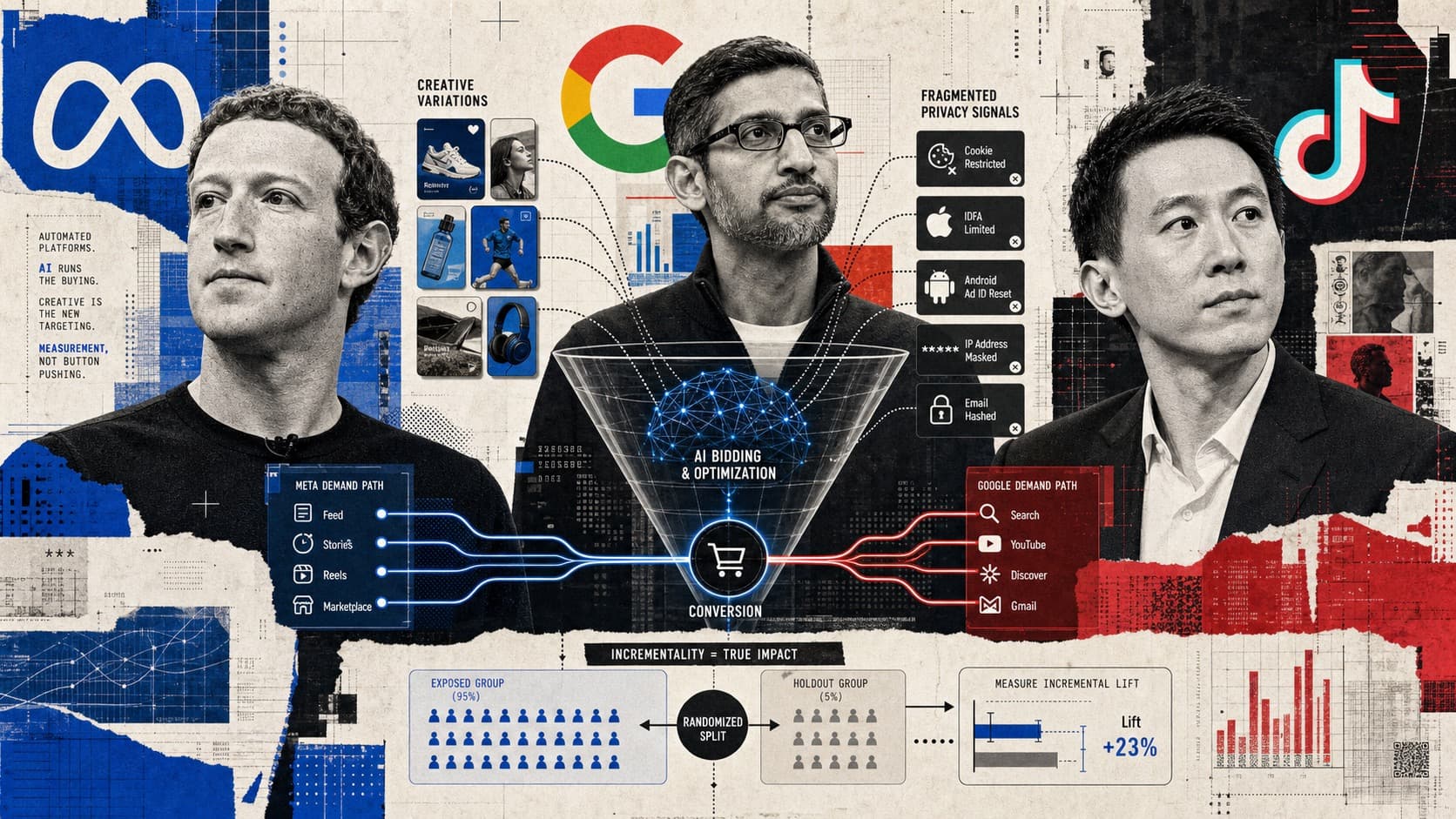
1. Signal loss. Privacy changes and platform opt-outs mean you no longer see most of what your customers do. iOS App Tracking Transparency opt-in rates alone range from 14% to 50% by app category (Adjust, 2025). The deterministic tracking the last decade was built on is now partial, and the winners plan around the gap instead of pretending it isn't there.
2. AI runs the buying. Bidding, audience selection, and increasingly creative assembly are automated inside the ad platforms. Your job shifted from manual targeting and bid management to feeding the machine well — clean conversion signals, strong creative, and clear goals — and judging the outcome.
3. Incrementality is back. When you can't track everything and the machine claims credit for everything, the only honest question is what your spend actually caused. That's incrementality, and it's the through-line of modern measurement.
The Metrics That Matter
You can't run performance marketing on one number, and treating any single metric as "the ROI" is the most common reporting mistake. Think of them as a stack:
MetricWhat it answersBest forCACWhat does one customer cost to acquire?Unit economics, efficiencyROASRevenue per unit of ad spend, per channelDaily pacingMERTotal revenue ÷ total marketing spendThe honest, un-gameable headlineLTV:CACDoes a customer pay back over time?Whether growth is healthy
The durable target most businesses manage to is LTV:CAC of roughly 3:1 — a benchmark from SaaS investor David Skok, who observed that the best businesses run higher than 3, sometimes as high as 7 or 8. Below 1:1 you lose money on every customer. Far above 5:1, you're probably under-investing in growth.
The discipline is reporting each metric at the level that matches the decision. Use ROAS to pace individual channels day to day. Never sum platform-reported revenue and call it company revenue — each platform claims credit for conversions it didn't solely cause. Use MER as the honest headline instead: total revenue divided by total marketing spend can't be gamed by platforms fighting over the same sale, which is why it's the number a CFO will trust. Manage the business itself to LTV:CAC and payback period, since a healthy ratio with an 18-month payback can still starve a company of cash. For channel targets by vertical, see our guide to what a good ROAS actually is. And when the denominator creeps up — as it has almost everywhere — our breakdown of why CAC keeps increasing covers the causes and the fixes.
The Channels
Performance marketing in our markets runs on three channel families, each with its own logic.
Meta (Facebook, Instagram, Threads). The demand-creation engine: it's exceptional at finding buyers who weren't searching for you, which makes creative the primary lever. How much a startup should put here — and how to scale it — is covered in how much a startup should spend on Meta ads.
Google (Search, Shopping, PMax). The demand-capture engine: it harvests intent that already exists. Most ecommerce brands need both, in a sequence that depends on whether people are already searching for you — the trade-off we work through in Google Ads vs Meta Ads for ecommerce in SEA.
App user acquisition. For app-first businesses, installs are worthless without retention. Scaling installs while holding onto users — and doing it through the signal-loss gap — is its own discipline, covered in how to scale app installs without losing retention.
The mix is a sequencing question, not a loyalty test. If customers are already searching for you, Google Search captures that intent cheaply. It should be funded to its impression-share ceiling first — paying to create demand you already have is waste. If nobody is searching for your category yet, Meta has to create the demand before Google can capture it, so the order inverts. Most brands need both. The mistake we see most often is running them as two disconnected budgets rather than one funnel — Meta primes the demand, Google harvests it, and the two should be measured together instead of each platform claiming full credit for the same customer.
Creative Is the New Targeting
Here's the strategic consequence of AI running the buying: as the platforms automate who sees your ads, the creative itself becomes your main targeting lever. What you say and show now decides who the algorithm finds — the ad is the audience signal.
That makes disciplined creative testing the highest-leverage work in the account, not an afterthought handed to a designer. The goal isn't one perfect ad. It's a system that produces a steady stream of varied concepts and learns from them fast — because creative fatigue is real, and winners decay.
In practice, that system has three parts. First, test concepts, not tweaks. A different hook, angle, or format teaches you far more than a new button colour, because the algorithm reads the whole creative as a signal of who to show it to. Second, give each test enough budget and time to clear the platform's learning phase before you judge it. Most "losing" ads were simply killed before they had the data to prove themselves. Third, feed the winners back in and retire the fatigued ones on a schedule, because a concept that worked last quarter is usually decaying now. Our creative testing framework covers how to structure, size, and read those tests without fooling yourself with noise.
Measurement in a Post-Signal World
This is where most of the 52% fall down. When tracking is partial and every platform over-claims credit, your reported numbers drift from reality — and usually flatter the spend. The scale of the gap is stark: across 2,226 randomised Meta experiments, standard last-click attribution explained just 19% of the variance in true incrementality (R²=0.19), versus 0.88 for an experiment-calibrated method (Gordon, Moakler & Zettelmeyer, arXiv:2304.06828).
Bar chart. 52 percent of senior marketing leaders can prove marketing’s value and get credit for it, rising to 62 percent among those who meet regularly with their analytics team. Source: Gartner 2024.52%All senior marketers62%Those who meet regularlywith their analytics teamCan prove marketing’s value and get credit for itSource: Gartner, 2024 (via Business Wire). Retrieved 2026-08-01
That doesn't mean measurement is hopeless — it means you build it in layers. Get the input right first with clean, server-side-supported conversion tracking. Understand what your attribution model can and can't tell you — our attribution & measurement guide maps the whole stack, from models to experiments. And build it all on a compliant first-party data foundation, because the rules differ by market and the durable signal is the data your customers give you directly.
The practical rule is to match the measurement to the stakes. For daily pacing, your always-on attribution model is fine — it's cheap and directional. For a decision big enough to hurt if you're wrong — cutting a whole channel, judging a brand campaign, deciding whether Meta is truly incremental — run an experiment instead. A geo holdout or conversion-lift test compares an exposed group against a randomly held-out one. That's the only method that measures cause rather than assuming it. The teams in the 62% — those who can prove value — are disproportionately the ones who meet their analysts and run those experiments, not the ones with the prettiest dashboard.
Running It as a System
The final shift in thinking: performance marketing isn't a stack of separate campaigns, it's one loop. Creative feeds the channels; the channels need clean signal; signal drives measurement; measurement tells you what to make more of. Break any link and the others degrade — great creative wasted on broken tracking, or perfect tracking measuring mediocre ads. For startups especially, wiring this into a repeatable system rather than a series of heroics is what turns paid spend into predictable growth; that's the subject of our guide to building predictable growth systems. And because our markets have their own economics, benchmark yourself against what's actually real for SEA and India, not against US-centric numbers.
Frequently Asked Questions
What is performance marketing?
Performance marketing is paid acquisition judged by a measurable return: you spend to drive a specific, trackable action — a purchase, lead, or install — and evaluate every unit of spend by what it delivered against a target like CAC, ROAS, or LTV:CAC. It differs from brand marketing, whose payoff is diffuse and long-term, by tying spend directly to accountable outcomes.
What are the most important performance marketing metrics?
They form a stack: CAC (cost to acquire a customer), ROAS (revenue per unit of ad spend, per channel), MER (total revenue ÷ total marketing spend), and LTV:CAC (whether a customer pays back over time). No single one is "the ROI" — report the level that matches the decision. Most businesses manage to an LTV:CAC of around 3:1 as a durable health target.
How is performance marketing changing in 2026?
Three shifts define it: signal loss (privacy and opt-outs mean you no longer see most user behaviour — iOS opt-in runs 14–50% by category), AI running the buying (bidding, targeting, and creative assembly are automated inside platforms), and the return of incrementality (with tracking partial and platforms over-claiming credit, what your spend actually caused becomes the real question).
Is Meta or Google better for performance marketing?
Neither is universally better — they do different jobs. Meta creates demand, finding buyers who weren't searching for you, which makes creative the main lever. Google captures existing demand through search intent. Most ecommerce brands need both; the right sequence depends on whether customers are already searching for you, which is the trade-off to work through channel by channel.
Why don't my reported ad numbers match actual revenue?
Because attribution over-credits and tracking is partial. Platforms claim conversions that would have happened anyway, and signal loss means many conversions are never observed. In the largest study, last-click attribution explained only 19% of true incrementality. Your real, incremental return is almost always lower than the dashboard shows — which is why big decisions need holdout experiments, not just attribution.
Why is creative so important in performance marketing now?
Because AI has automated audience targeting inside the ad platforms, the creative itself has become the main targeting signal — the ad effectively selects its own audience. That makes a disciplined system for producing and testing varied creative the highest-leverage work in an account, since the algorithm finds buyers based on what your creative says and shows.
Conclusion
Performance marketing in 2026 is still about accountability to a number — but the numbers got harder to trust, the machines got smarter, and the honest question became incrementality rather than attribution. Win it by treating the pieces as one loop: strong, constantly-tested creative feeding clean signal into automated channels. Measure it all up a stack that separates what you caused from what you were merely credited for. Do that and you land in the 52% who can prove their value — and, increasingly, pull ahead of those who can't.
How this post was compiled. The Gartner "52% / 62% can prove value" figures are from Gartner's 2024 survey via Business Wire; the incrementality figures (last-click R²=0.19 vs 0.88 across 2,226 experiments) are from the peer-reviewed PIE study (Gordon, Moakler & Zettelmeyer, arXiv:2304.06828); the iOS opt-in range (14–50%) is Adjust's 2025 data; the ~3:1 LTV:CAC target is attributed to David Skok / Matrix Partners. The three-shifts framing and the channel and creative sections are presented as analysis. Written by Abhilash LR, founder of Coact, a performance marketing agency working across Singapore, India, and Indonesia.
Continue Learning
What's a Good ROAS by Industry? — set channel targets from your margins
Why Is My CAC Increasing? — the causes, and what to do
Creative Testing for Performance Marketing — the highest-leverage work in the account
Attribution & Measurement — what actually tells you what's working
Building Predictable Growth Systems for Startups — wire it into a repeatable system
Talk to our team about running performance marketing that proves its value.
Want results like these for your brand?
COACT runs performance-based growth across SEA & India. Start with a free 15-day pilot.
Book a discovery callKeep reading
How to Measure Marketing ROI (Without Fooling Yourself)
Marketing ROI is a one-line formula. The trap is the inputs: only 52% of marketers can prove their value, and reported ROI overstates what you actually caused.
AEO & GEO in 2026: A Guide for Southeast Asian Brands
The one peer-reviewed study of AI-search visibility found adding statistics lifts citations 37% — and keyword stuffing cuts them 9%. What works, sourced.