D2C Attribution and Incrementality: What to Demand in India
D2C measurement needs three layers: first-party order truth, reconciled attribution and incrementality tests. What to ask an Indian agency and what drives cost.
By Abhilash LR
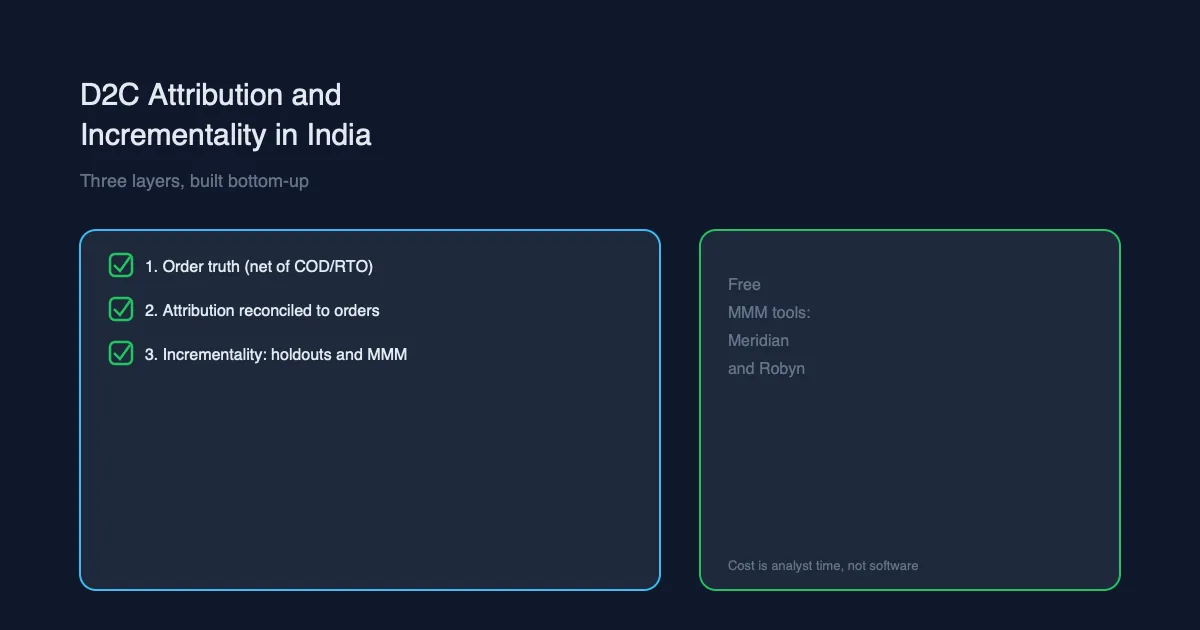
A D2C brand in India should look for an agency that builds three layers of measurement: a first-party record of orders as the source of revenue truth, attribution reconciled against that record, and incrementality tests that show what ads actually caused. The cost depends on setup engineering, ongoing reporting and the number of tests, and we found no published India price ranges for it, so ask for an itemised quote. The modelling tools themselves, Google's Meridian and Meta's Robyn, are free and open source, which means you are paying for people and data work, not software.
Key Takeaways
- Layer 1, order truth. Your Shopify, ERP or order database is the source of revenue, net of refunds, cancellations and, in India, COD refusals and return-to-origin (RTO).
- Layer 2, reconciled attribution. Platform dashboards are claims, not records. They must be reconciled to orders, because Meta and Google can each legitimately claim the same sale.
- Layer 3, incrementality. Geo or cohort holdouts, and marketing mix models, estimate what ads caused. Multi-touch attribution alone cannot prove causality.
- Cost is mostly labour. Google Meridian and Meta Robyn cost nothing to license; setup, data prep and analysis are what you pay for.
What Should the Measurement Foundation Include?
Start with orders, not ads. The foundation has three parts.
- First-party order truth. Revenue, refunds, cancellations and returns come from your order system. In India, include COD refusals and RTO, which platform dashboards never see. Our guide to measuring marketing ROI explains why reported ROI overstates what you caused.
- Clean, server-side events. Meta's Conversions API and Google's Enhanced Conversions send hashed customer data so platforms can match conversions the browser misses. Confirm they are sending, not just connected. Our conversion tracking guide shows how.
- Identity stitching. Link order and customer IDs to acquisition source, first purchase and repeat purchase, so you can see lifetime value by channel.
How Should Attribution Be Reported?
Reconcile every platform's revenue to actual orders. Each platform only sees its own touchpoints, so the sum of reported conversions across platforms usually exceeds real sales. Ask the agency to show platform-reported revenue next to order-system revenue each month, with the gap explained. For model choices, see which attribution model to use.
How Is Incrementality Actually Tested?
Incrementality asks whether a sale would have happened without the ad. Ask which of these the agency runs:
| Method | What it does | Good for | Limit |
|---|---|---|---|
| Geo holdout | Reduce or pause a channel in some regions and compare to control regions | Channel-level decisions | Needs enough regional volume |
| Cohort holdout | Withhold ads from a random audience share | Retargeting and CRM | Needs platform support |
| Platform lift study | Platform-run randomised test | A quick causal read on one platform | Platform-designed |
| MMM or "MMM-lite" | Statistical model of sales against spend over time | Budget planning across channels | Needs history; not plug and play |
A holdout needs a pre-agreed design: the control, the window, the sample size and the decision threshold. The right length depends on your purchase cycle and order volume, so an agency should explain its power assumptions before running a test. Multi-touch attribution tools such as Triple Whale help attribute across touchpoints, but they do not prove causality; holdouts and MMM complement them.
What Does It Cost?
We could not find published India price ranges for attribution or incrementality work, so treat any single quoted figure with caution. The cost has three drivers:
- Setup and engineering. Server-side tracking, event cleanup, identity stitching and the first reconciliation.
- Ongoing reporting. Monthly reconciliation, dashboards and attribution runs.
- Each test. Design, running, statistical analysis and the window it ties up.
Because the leading open-source MMM tools are free, the fee mostly buys analyst time and data preparation. Ask for the three items separately, plus tool subscriptions, excluding GST.
What to Ask in a Proposal
- Which source is the revenue "source of truth", and how is it mapped?
- How do you reconcile platform conversions to orders, and what gap do you consider acceptable?
- How do you handle COD, RTO, refunds and repeat customers?
- What incrementality designs do you run, with what sample sizes, windows and decision rules?
- Who builds and maintains the tracking, and who owns the data and models?
Check Your Current Setup Before You Buy More
If you are not sure whether your tracking is trustworthy today, start there. Loupe is COACT's one-time Meta and Google Ads audit: 133 checks across five categories, with measurement and data integrity first, a report in 3-7 business days, $199-$399 and no retainer. See the sample report before you decide. It suits D2C and ecommerce brands already spending roughly ₹2.5 lakh or US$3,000 a month.
Want a Team to Build the Measurement Stack?
If you would rather have an expert team set up tracking, reconcile attribution and run incrementality tests alongside the media, book a free strategy call with COACT. COACT's stated approach unifies tracking across channels and fixes attribution gaps; you can ask how that would work on your orders.
Frequently Asked Questions
Is platform-reported ROAS enough for decisions?
No. Platform ROAS reflects credit within that platform's own attribution rules and can double-count the same sale across platforms. Reconcile it to your order data, then use incrementality tests to learn what actually drove new sales.
How long should an incrementality holdout run?
It depends on your purchase cycle, volume and the lift you need to detect. Short campaigns often run for a few weeks, but an agency should state its sample-size and confidence assumptions before launching any test.
Do I need all three layers at once?
Build the foundation first, because everything else depends on it. Reconciled attribution and periodic incrementality tests can be phased in, but you need all three before scaling decisions are reliable.
Will a multi-touch attribution tool replace geo holdouts or MMM?
No. Multi-touch tools distribute credit across touchpoints but do not prove causality. Holdouts and marketing mix models measure incremental impact and effects that attribution models can miss.
Do I have to pay for MMM software?
Not necessarily. Google Meridian and Meta Robyn are both open source. Neither is plug and play, so the cost is the analyst time to prepare data, run the model and interpret it.
What is the minimum I should do if my budget is small?
Fix order truth and server-side tracking first, reconcile platform revenue to orders monthly, and run one simple holdout when you reach enough volume. That covers most of the avoidable measurement errors at low cost.
Sources and method: Product behaviour is from Meta's Conversions API documentation and Google Ads Help on Enhanced Conversions, both read directly. Open-source MMM tools: Google Meridian and Meta Robyn. No India price range for measurement services was found, so none is stated. COACT and Loupe details are from COACT's own site.
Abhilash LR leads growth marketing at Coact, working with performance and D2C brands across India, Singapore, and Indonesia.
Want results like these for your brand?
COACT runs performance-based growth across SEA & India. Start with a free 15-day pilot.
Book a strategy callKeep reading
Ecommerce Conversion Rate India, Indonesia: What Vendors Say
Vendors put India's D2C conversion rate at 1.5-2.5% and Indonesia at 0.8-2.4%. See why the figures conflict and how to measure your own from store orders.
Southeast Asia CAC Benchmarks 2026: What Data Exists
Singapore's median Meta CPC is near the global median (SGD 1.00 vs 1.04); the Philippines' is 93% lower. No SEA CAC-by-industry study exists; see the data.