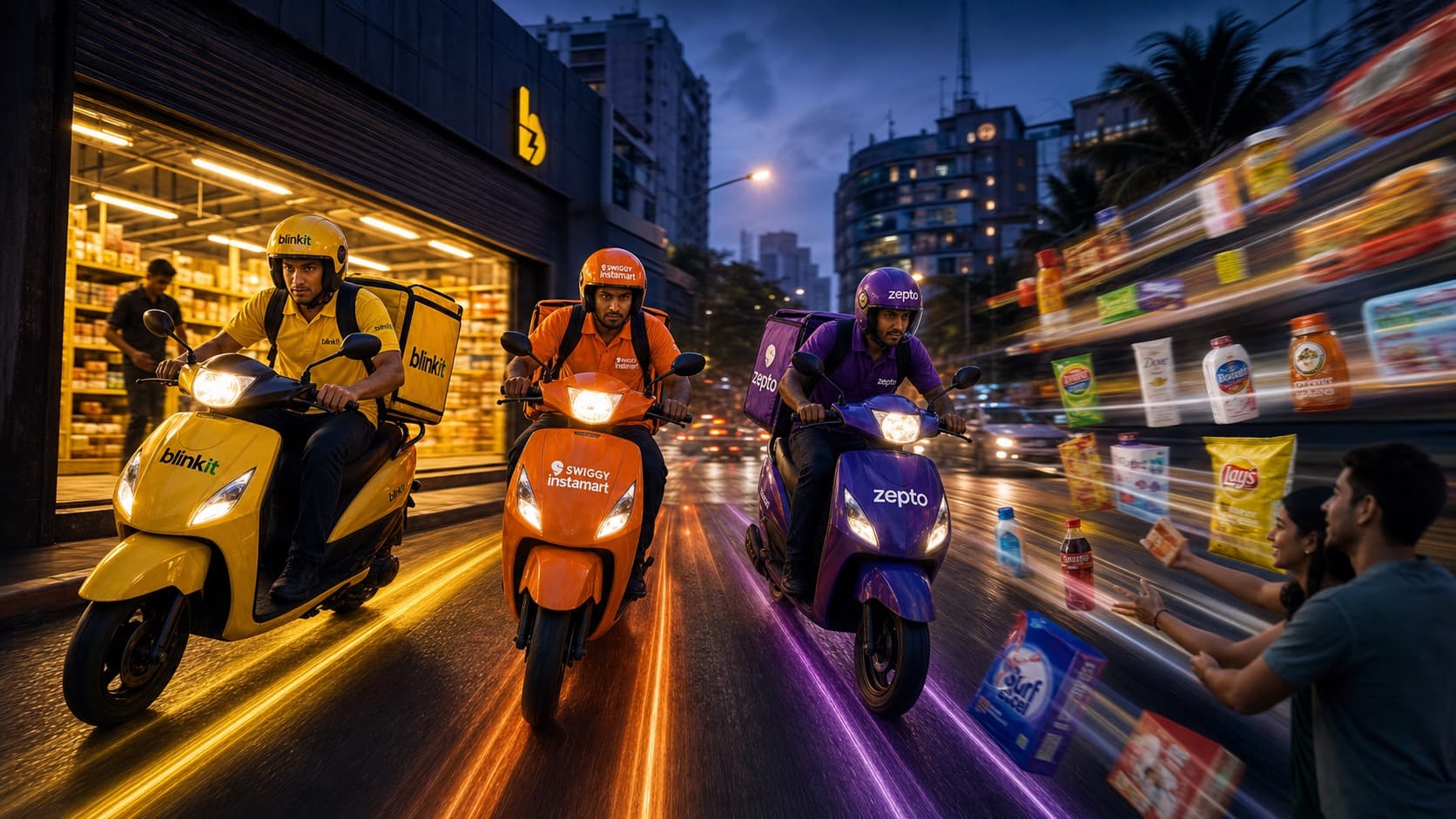
Quick Commerce in India: What Brands Need to Know (2026)
Blinkit's quarterly GOV (₹11,821 cr) overtook Zomato's food delivery. Quick commerce is now a primary channel for Indian consumer brands — here's the playbook.
By Abhilash LR
Here is the number that ended the "is quick commerce a real channel?" debate in India. In the quarter ended June 2025, Blinkit's gross order value hit ₹11,821 crore, overtaking Zomato's food-delivery business (₹10,769 crore) for the first time (Eternal Q1 FY26 results; primary filings are at Eternal's investor relations page). At India's biggest food-delivery company, 10-minute grocery is now the bigger business. If you sell a consumer product in India, quick commerce is no longer an experiment to watch — it's a channel to plan for.
This is what brands actually need to know: how big and fast it really is, who the players are, what it changes about your product and margins, and how to decide whether — and how — to be on it.
Key Takeaways
Quick commerce has crossed from niche to primary channel: Blinkit's quarterly GOV (₹11,821 cr) overtook Zomato's food delivery in Q1 FY26.
It's a three-player market — Blinkit, Swiggy Instamart, and Zepto — and growth is still triple-digit year-on-year, though it's cooling quarter to quarter.
Quick commerce rewrites your assortment, pack sizes, and margins: dark-store shelf space is scarce, take rates are high, and the winners treat it as its own channel, not a shelf-extension of retail.
It suits impulse and replenishment categories best. For considered purchases it's a discovery and convenience layer, not your main funnel.
How Big, How Fast — the Honest Numbers
The headline milestone is Blinkit overtaking food delivery, but the trajectory matters more than any single quarter.
Bar chart. In the quarter ended June 2025 (Q1 FY26), Blinkit’s quick-commerce gross order value reached 11,821 crore rupees, overtaking Zomato’s food-delivery gross order value of 10,769 crore rupees for the first time.₹11,821 crBlinkit (quick commerce)₹10,769 crZomato (food delivery)Gross order value, quarter ended June 2025 (Q1 FY26)For the first time, quick commerce was the bigger business.Source: Eternal (Zomato parent) Q1 FY26 results. Retrieved 2026-08-01
Growth is still steep but decelerating, which is the normal maturing of a hot category. Analysts at ICICI Securities estimated Blinkit's GOV grew roughly 140% year-on-year in Q1 FY26 (about 25% quarter-on-quarter), with Swiggy Instamart up around 110% YoY (about 22% QoQ), while overall sector growth slipped below 20% quarter-on-quarter — a sign the leaders are taking share as the category as a whole cools (Inc42, citing ICICI Securities). Treat the exact YoY figures as analyst estimates rather than audited numbers; the direction — very fast, but slowing — is the reliable part.
The practical read for a brand: this is a channel large enough to matter to your P&L and still growing faster than almost anything else in Indian retail, but it's past the land-grab phase where anything sells. The bar for winning is rising.
The Three-Player Market
India's quick commerce has consolidated into three serious platforms, each with a different backer and posture:
Blinkit (owned by Eternal, formerly Zomato) — the clear leader by GOV, and now the growth engine of its parent.
Swiggy Instamart — the closest challenger, backed by Swiggy's food-delivery network and rider fleet.
Zepto — the venture-funded pure-play that pioneered the 10-minute promise; it has recently prioritised reducing cash burn over aggressive expansion.
For a brand, the implication is concrete: this is a three-account channel, not a marketplace with a long tail. You are negotiating listings, availability, and ad spend with three counterparties who control the digital shelf — much closer to modern-trade retail buying than to running a Shopee or Amazon storefront.
What Quick Commerce Changes for Your Brand
The mistake most brands make is treating quick commerce as "ecommerce, but faster." It isn't. Three structural differences rewrite how you operate.
1. The shelf is tiny. A dark store stocks a few thousand SKUs, not the tens of thousands in a hypermarket or on a marketplace. Assortment is ruthlessly curated to fast-movers. If your product isn't a proven rate-of-sale winner, it won't earn shelf space — and "available in the app" is meaningless if it's out of stock in the dark store nearest the customer.
2. Pack sizes and price points shift. Quick commerce skews to immediate need — single-serve, smaller packs, impulse and replenishment. The large value pack that works in modern trade is often the wrong hero SKU here. Winners design quick-commerce-specific packs and price points rather than porting their retail range.
3. Margins are thinner than they look. Platforms monetise through commissions/take rates plus a fast-growing ad business, and delivery economics are expensive. The effective margin you keep after platform fees and the retail-media spend needed to stay visible is materially lower than a shelf in general trade. Model the channel on its own contribution, not on gross revenue.
Retail Media Is the Real Cost of Entry
The part brands underestimate most: on quick commerce, visibility is bought, not earned. The same platforms taking a commission also run ad auctions for search placement, category banners, and sponsored slots on a shelf where the top few results capture most demand. As the category's organic growth cools, being findable increasingly means paying for it — which is exactly why the platforms are leaning into ad monetisation.
Practically, budget quick commerce like a performance channel with its own ROAS target built from your margins, not like a listing you set and forget. The brands that win treat platform ads, pricing, and availability as one connected system, and measure the channel's true contribution after all of it — the same discipline that keeps rising CAC from quietly eating your growth elsewhere.
What It Means for Traditional Retail and Distribution
Quick commerce doesn't just add a channel — it compresses the chain. A dark store is fed close to directly by brands or large distributors. That squeezes out the layers of wholesalers and sub-distributors that classic Indian distribution runs through. It also competes head-on with the neighbourhood kirana store for the exact impulse and top-up purchases that were traditionally theirs. That tension draws attention from trade bodies and regulators worried about the displacement of millions of small retailers. It's a live enough issue that any brand's channel plan should assume the rules could tighten.
Our view for brands is to treat quick commerce as additive, not a replacement — at least for now. General trade and modern trade still move the overwhelming majority of India's consumer volume. Abandoning them to chase a fast-growing but still-small dark-store channel is a classic case of over-rotating to the newest thing. The smarter posture is to win the quick-commerce shelf for the SKUs and moments where immediacy matters, while protecting the distribution and kirana relationships that still carry your base. Keep an eye on the regulatory conversation too — it can reshape the economics faster than the platforms will.
Is Quick Commerce Right for Your Brand?
It depends far more on your category than on your ambition.
Fits quick commerce wellFits poorly / use selectivelyImpulse and treat purchases (snacks, beverages, ice cream)High-consideration, research-heavy productsReplenishment staples (groceries, personal care, pet)Large, expensive, or infrequent purchases"Forgot an ingredient" and emergency needsProducts needing demonstration or fittingSmall, high-rate-of-sale packsWide-assortment ranges that need full shelf breadth
If you're in the left column, quick commerce is becoming a core availability channel and being absent is a real gap. If you're in the right column, it's a convenience and discovery layer worth testing selectively — not your primary funnel. Either way, the brands getting it right start narrow: a handful of hero SKUs, in the cities and dark stores where their demand actually is, measured honestly before scaling.
Frequently Asked Questions
How big is quick commerce in India?
It has become a primary retail channel rather than a niche convenience. The clearest marker is that in the quarter ended June 2025 (Q1 FY26), Blinkit's gross order value reached ₹11,821 crore, overtaking Zomato's own food-delivery GOV of ₹10,769 crore for the first time (Eternal Q1 FY26 results) — meaning 10-minute grocery became the larger business at India's biggest food-delivery company. It's a genuinely three-player market between Blinkit, Swiggy Instamart, and Zepto. Category growth is still triple-digit year-on-year by most analyst estimates, though it is cooling quarter to quarter as the market matures and moves beyond the early land-grab. For a consumer brand, the practical takeaway is that quick commerce is now large enough to matter to your revenue and still growing faster than almost anything else in Indian retail — but the bar to win on it is rising as the category consolidates around the leaders.
Who are the main quick commerce players in India?
Three platforms dominate India's quick commerce market, and there is no meaningful fourth. Blinkit, owned by Eternal (formerly Zomato), is the category leader by gross order value, having overtaken Zomato's own food-delivery business in Q1 FY26. Swiggy Instamart, backed by Swiggy's existing logistics and customer base, is the closest challenger and growing at a similarly steep rate. Zepto is the venture-funded pure-play that popularised the 10-minute delivery promise and forced the category into existence in the first place. For a consumer brand, this concentration matters practically: quick commerce is effectively a three-account channel where a small number of category managers and ad-auction algorithms control the digital shelf. Unlike a fragmented marketplace or general trade, where relationships and distribution can be built gradually across thousands of outlets, winning on quick commerce means winning the attention of three platforms — which rewards brands that can move fast and negotiate well with a concentrated set of gatekeepers.
Is quick commerce profitable for brands?
It can be, but margins are thinner than they look at first glance. Platforms take a commission on every order, and as organic visibility fades with category growth, brands increasingly need ad spend just to stay findable on a shelf where the top few search results capture most demand. Delivery economics add another layer of cost that a traditional retail shelf doesn't carry. Brands that get burned tend to assume quick commerce inherits the margin structure of general trade or ecommerce marketplaces — it doesn't. The brands that make it genuinely profitable treat it as its own channel with its own economics: a margin-based ROAS target calculated after platform commission and ad spend, not before it, and quick-commerce-specific pack sizes and price points designed for the channel rather than ported from a hypermarket range. Get those two things right and the channel can be a real profit contributor, not just a volume or visibility play.
What products sell best on quick commerce?
Impulse and replenishment categories perform best: snacks, beverages, everyday groceries, personal care essentials, and "forgot an ingredient" emergency needs, almost always in smaller, single-serve, or convenience-sized packs rather than bulk value packs. These categories work because they match the two things quick commerce is actually built for — immediate need and a tightly curated, fast-moving dark-store shelf that only holds a few thousand SKUs. High-consideration purchases fit poorly for the same structural reason: a dark store has no room for the wide assortment or in-depth browsing that expensive or infrequent purchases usually need, and customers researching a considered purchase aren't reaching for a 10-minute delivery app anyway. Products that need physical demonstration, fitting, or comparison shopping — electronics, apparel, furniture — also tend to underperform on the channel. The practical filter for any brand is simple: if a customer would buy it on impulse or because they ran out, it's a quick-commerce fit; if they'd research it first, it isn't.
How is quick commerce different from ecommerce marketplaces?
The core difference is shelf size. A dark store holds only a few thousand fast-moving SKUs, curated ruthlessly for rate of sale, versus the near-infinite assortment a marketplace like Amazon or Flipkart can list without ever running out of shelf space. That single fact changes what "success" means: on a marketplace, being listed is most of the battle, and a slow-moving SKU can sit indefinitely without cost. On quick commerce, availability and rate-of-sale are decisive — being "listed" in the app is meaningless if the local dark store nearest the customer is out of stock, and a slow-moving SKU gets delisted to make room for something that sells faster. Quick commerce also concentrates commercial power in three platforms rather than spreading it across a long-tail marketplace with millions of sellers, which makes it operate less like an online storefront and more like modern-trade retail buying, where a handful of category managers decide what earns shelf space and on what terms.
Do I need to advertise on quick commerce platforms?
Increasingly, yes — treating a quick-commerce listing as a passive line item is a losing strategy. Visibility on these platforms is largely bought rather than earned: the same companies taking a commission on your orders also run search and category ad auctions, and as the category's explosive organic growth cools, paid placement becomes the main lever for staying findable on a shelf where the top few search results capture most of the demand. Brands that skip advertising tend to see their organic rank quietly erode as competitors who do pay for visibility take the top slots. The right way to budget for this isn't to treat quick-commerce ads as a marketing nice-to-have, but to run the channel like any other performance channel: set a margin-based ROAS target that already accounts for platform commission, measure spend against it consistently, and adjust bids the way you would on Meta or Google rather than setting a listing once and leaving it alone.
Conclusion
Quick commerce in India crossed a line in 2025: at the country's biggest food-delivery company, 10-minute grocery became the larger business. For consumer brands, that ends the debate about whether it's a real channel and starts a harder one — how to win on a tiny, expensive, three-player shelf where availability and paid visibility decide everything. The answer isn't to be everywhere at once. It's to pick the hero SKUs and cities where your demand is real, design for the channel rather than porting your retail range, and measure the true contribution before you scale.
How this post was compiled. The Blinkit and Zomato Q1 FY26 gross order value figures (₹11,821 cr vs ₹10,769 cr) are from Eternal's Q1 FY26 results as reported by Business Standard. The growth-rate estimates (Blinkit ~140% YoY, Instamart ~110% YoY, sector below 20% QoQ) are ICICI Securities analyst estimates via Inc42, and are flagged as estimates rather than audited figures. Structural points about assortment, pack sizes, take rates, and retail media reflect how the channel operates and are presented as analysis, not as sourced statistics. Written by Abhilash LR, founder of Coact, a performance marketing agency working across Singapore, India, and Indonesia.
Continue Learning
SEA & India Growth Benchmarks: What's Real — the wider regional data, with the same verify-everything discipline
How to Lower CAC for D2C Brands — the acquisition side of the equation
What's a Good ROAS by Industry? — set a margin-based target for channel spend
Talk to our team about building a quick-commerce channel strategy that actually pays back.
Want results like these for your brand?
COACT runs performance-based growth across SEA & India. Start with a free 15-day pilot.
Book a discovery callKeep reading
How to Measure Marketing ROI (Without Fooling Yourself)
Marketing ROI is a one-line formula. The trap is the inputs: only 52% of marketers can prove their value, and reported ROI overstates what you actually caused.
AEO & GEO in 2026: A Guide for Southeast Asian Brands
The one peer-reviewed study of AI-search visibility found adding statistics lifts citations 37% — and keyword stuffing cuts them 9%. What works, sourced.